
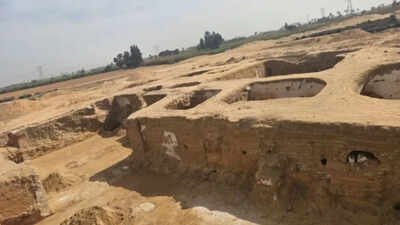
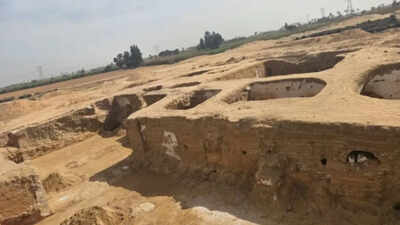
Egypt has once again drawn attention from the archaeological world after researchers uncovered a large monastic complex believed to be around 1,500 years old. The site sits in the Nile Delta, a region already known for layers of ancient settlement and religious history. Officials from Egypt’s Ministry of Tourism and Antiquities announced the discovery after years of ongoing excavation work. The remains appear to offer a rare glimpse into how early Christian monastic communities lived, organised themselves, and adapted their spaces over time. It is not just a single building, but a structured complex with multiple rooms, communal areas, and symbolic elements. Experts say the find could help fill gaps in understanding the early development of organised monastic life in Egypt. There is also a sense that the site reflects a transition in religious living patterns. From isolation to community. Quietly preserved beneath layers of soil for centuries.
Archaeologists uncover 1,500-year-old monastic complex in Egypt’s Nile Delta
The excavation took place at the Al-Qalāyā archaeological site, located within Beheira Governorate in the Nile Delta. Work at the site has been ongoing since 2023, carried out by teams linked to the Supreme Council of Antiquities. The location itself is not new to historical interest, but this particular structure appears to stand out because of its scale and organisation. It is described as a major monastic centre rather than a small isolated dwelling.Some researchers suggest the setting may have supported both religious practice and community interaction in ways not always seen in desert monastic sites further south. The newly uncovered building contains 13 rooms. Each space seems to have had a specific purpose. Some were used as individual living quarters for monks. Others appear to have been shared spaces.There are indications of a kitchen area, storage rooms, and sections that may have supported teaching or daily communal activities. A large hall with stone benches stands out. The benches are decorated with botanical motifs. It likely served as a reception space for visitors or senior religious figures. The building follows a north-south alignment. Inside, a prayer room faces east. A limestone cross is set into one of the eastern walls. These details reflect common architectural choices associated with early Christian worship spaces.
Daily life evidence uncovered at the Al-Qalāyā archaeological site
Archaeologists have found a range of materials that point to everyday activity. Pottery fragments, ceramic pieces inscribed with Coptic writing, and remains of food sources such as bird bones and oyster shells were recovered across the site.A complete marble column, measuring about two metres, was also uncovered, along with column capitals and bases. These elements suggest that the complex had both functional and decorative aspects. The site was not purely religious in isolation. It also supported practical living needs. Cooking, storage, and maintenance all appear to have been part of the routine environment.
Al-Qalāyā archaeological site mural and inscription finds
The wall paintings uncovered at the site include depictions of monks dressed in costumes that are typical of early monasticism. These images are accompanied by geometric patterns and floral motifs. The use of red, white, and black braided patterns is common. Another image includes the representation of an eight-petaled flower.An illustration in one painting shows two deer confined in a round shape. Scholars indicate that such depictions could hold a deeper meaning, perhaps reflecting ideas of harmony and meditation.One piece of limestone located close to an entry point contains a Coptic script. Early interpretations reveal that this is a funerary stele, which refers to a person known as “Apa Kyr, son of Shenouda.”
Evolution of monastery design at the Al-Qalāyā archaeological site
Researchers believe the complex shows a shift in monastic life. Early monasticism often involved solitude, with individuals living in isolation. Over time, communities began forming shared spaces.This site appears to reflect that transition. Individual cells exist alongside communal rooms and visitor areas. It might indicate a structured system where monks lived, learned, and interacted within a single organised environment.Hisham El-Leithy, a senior figure associated with the excavation, has described Al-Qalāyā as one of the largest known monastic gathering sites linked to early Christian monastic history. The architectural features seem to align with what experts consider early stages of monastery development.