
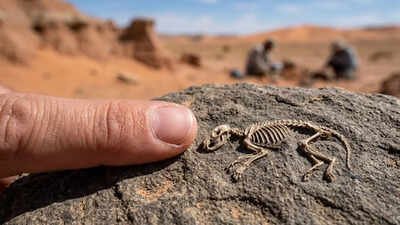

Palaeontologists have discovered an incredibly well-preserved fossil skeleton measuring only 1 centimetre long in the Ukhaa Tolgod area of the Gobi Desert. This fossil is believed to be one of the earliest examples of what are referred to as ‘micro-mammals’ from the Late Cretaceous time period. The American Museum of Natural History (AMNH), which was involved in the Mongolian-America Museum Expedition (MAME), states that finding a complete and intact specimen at this tiny size (about the size of a fingernail) is very uncommon. Items like teeth are found more commonly than this, but fossils are exceedingly hard to find due to their fragile nature.
1-centimetre fossil found in Mongolia: A tiny survivor from the age of dinosaurs
According to the American Museum of Natural History, locating a fully articulated skeleton with intact soft-tissue impressions at only one centimetre in size is an extremely rare occurrence for the Late Cretaceous. The Gobi desert is well known for its large dinosaur fossils, and now this ‘micro mammal’ fossil from the Late Cretaceous represents a ‘first of very few’ as fossils of such delicate creatures such as this are generally destroyed over the course of millions of years by forces of nature. This unique-looking creature closely resembles a shrew and is categorised as an advanced Mesozoic insectivore, a stem-mammal that survived alongside the Velociraptor.
How the fossil survived
The only reason a creature with such a fragile skeleton could survive is due to a process called ‘protracted aridification.’ According to the research, the Gobi Basin experienced intercontinental aridification approximately 75 million to 100 million years ago, driven by the rising of nearby mountain ranges. Animals that were small enough to become buried by massive sandstorms had their remains buried almost instantly in fine, dry sand. The quickness of these procedures helped save these small bones from rotting, being washed away, and served as a natural ‘time capsule’ for nearly 100 million years.
Life in an extreme climate
A one-centimetre fossil provides evidence of how living organisms adapted to the extremes of the environment of the Gobi Desert, which has a very seasonal climate. As the Gobi was drying up, the insect-eating animals were able to adapt and live in this area without any access to fresh water. The Eastern Gobi Basin has been identified as one of the ‘intercontinental’ regions that are experiencing the greatest amount of change due to climate change, providing additional context to the tiny fossil about how previous generations of mammals survived extreme global warming.
How do scientists study a fossil only 1 centimetre long?
Because of the size, scientists cannot use traditional hammers, and chisels cannot be used due to the size and fragility of the skeleton. High-Resolution Micro-CT Scanning is being utilised for these specimens to enable researchers to see through the rock and create a digital 3D model of the 1-centimetre skeleton (with all the details in relation to the teeth and inner ear), creating a ‘Digital Twin’ of the 1-centimetre skeleton to allow global study while preserving the original specimen.