
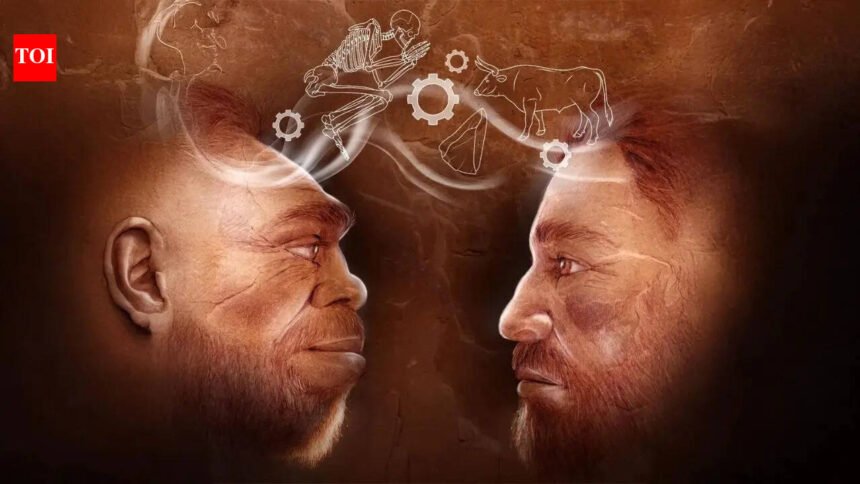

The first published research from Tinshemet Cave is quietly reshaping how scientists look at the relationship between Neanderthals and Homo sapiens. It is not just about two groups coexisting in the Levant during the mid-Middle Palaeolithic. The evidence points to something closer, more tangled, shared tools, habits, and even shared burial practices. The site suggests that early human history in this region was not split into neat lines of separation. Instead, it looks more like a long stretch of contact, movement, and exchange. A kind of cultural overlap that might have shaped behaviour in unexpected ways. The Levant, in the picture, appears less like a boundary and more like a meeting point where different human groups kept crossing paths.
The Tinshemet cave study shows possible exchange between Neanderthals and early humans
Tinshemet Cave, located in central Israel, has been under excavation since 2017. Led by researchers from the Hebrew University of Jerusalem and Tel Aviv University, the site has already produced findings that feel important for understanding early humans.The study, published in Nature Human Behaviour, is the first detailed report from the site. It highlights a mix of human remains, tools, and ritual evidence. What stands out is not just the age of the material but the way it all seems connected across different human groups. Neanderthals, early Homo sapiens, and possibly pre-Neanderthal populations may all have moved through the same landscape.The stone tools found at Tinshemet Cave show patterns that experts say are not easily assigned to a single group. Some techniques resemble Neanderthal methods, while others align more closely with early Homo sapiens traditions.Hunting strategies also seem to reflect shared knowledge. Animal remains suggest coordinated use of local resources, although details are still being studied.
Tinshemet cave burials and early evidence of ritual behaviour
One of the strongest findings from the cave is the presence of multiple human burials. These are reportedly the first mid-Middle Palaeolithic burials found in the region in more than fifty years. The graves include stone tools, animal bones, and pieces of ochre. The arrangement suggests intention. Around 110,000 years ago, formal burials began to appear in this part of the world. Tinshemet Cave adds weight to that timeline. It might even suggest that burial practices were not limited to one group. Instead, they could have spread across populations through contact.Experts say this hints at stronger social bonds than previously assumed.
Tinshemet cave ochre use and early symbolic behaviour
Ochre use at the site is widespread. Red and orange pigments appear across different layers of excavation. Researchers think it may have been used for body decoration. That idea carries implications. Decoration is not just practical. It suggests identity, or group signalling. It might show early symbolic thinking, although certainty is still out of reach. Some researchers propose that Neanderthals and Homo sapiens may have shared symbolic practices in this region. Not identical cultures but overlapping ones.
How the Levant shaped early human contact during the Middle Palaeolithic
The Levant during the mid-Middle Palaeolithic was not space between groups. It appears to have been densely used, especially during periods of favourable climate. Prof. Yossi Zaidner and colleagues describe the region as a kind of “crossroads”. Populations moved through, stayed for generations, then moved again. Contact was likely frequent. Dr. Marion Prévost has suggested that demographic growth in the region may have intensified these interactions. More people in the same area usually means more overlap. More exchange. Sometimes competition too.
Ongoing excavations and changing views on early human evolution
Tinshemet Cave is still being excavated, and only the first set of results has been published. More findings are expected in the coming years.What is already clear is that the site challenges older ideas about strict separation between Neanderthals and Homo sapiens. Instead of isolated groups, the evidence leans toward contact zones where cultures shifted over time. The picture is not fully complete yet. But it is starting to look less like parallel lines of evolution and more like intersections that shaped early human society in the Levant.