
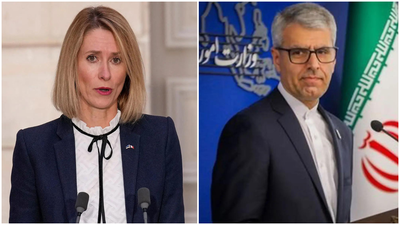

File photo: EU foreign policy chief Kaja Kallas and Iran’s foreign ministry spokesperson Esmail Baghaei
Iran on Sunday sharply criticised the European Union over its position on transit rules in the Strait of Hormuz, accusing it of double standards amid escalating tensions linked to the ongoing US-Iran conflict.Iran’s foreign ministry spokesperson Esmail Baghaei hit out at EU foreign policy chief Kaja Kallas, saying Europe invokes international law selectively. “Oh, that ‘international law’?! The one that the EU dusts off to lecture others while quietly green-lighting a US-Israeli war of aggression… Spare the sermons,” he said, calling Europe’s stance “peak hypocrisy.”Baghaei asserted that Iran, as a coastal state, has the right to regulate movement in the strategic waterway and pushed back against calls for unrestricted passage.
Iran defends Hormuz controls, rejects ‘unconditional transit’
Baghaei said Tehran is within its rights to act in the Strait, stressing, “No rule of international law forbids Iran… from taking necessary measures to stop the Strait of Hormuz being used for waging military aggression against Iran.”He also dismissed the concept of free passage under current conditions, saying, “‘Unconditional transit passage’ in Hormuz? That fiction sailed the moment US/Israeli aggression brought US military assets into the strait’s backyard.”
EU warns against transit fees, offers maritime support
His remarks came after Kallas emphasised that transit through key waterways must remain open and free, warning that any “pay-for-passage scheme will set a dangerous precedent for global maritime routes”.She added that Europe could play a role in restoring normalcy once hostilities ease, noting that the EU’s Aspides naval mission could be strengthened to protect shipping across the region.
Tensions rise as Iran signals stricter measures
The exchange comes after Iran indicated it may prioritise vessels willing to pay fees under new transit protocols, citing limited capacity. The situation escalated further after Iran’s Revolutionary Guard announced that the Strait would remain closed, warning that any vessel approaching it could be “targeted.”The developments come amid broader tensions over the US naval blockade on Iranian ports. Iran has said the Strait of Hormuz will not fully reopen unless the United States lifts the blockade, with Mohammad Bagher Ghalibaf, speaker of the Iranian parliament, warning that a final peace deal remains “far” off.The Strait, which carries nearly a fifth of the world’s oil and gas supply, remains central to the crisis, with its disruption continuing to impact global trade and energy markets.