
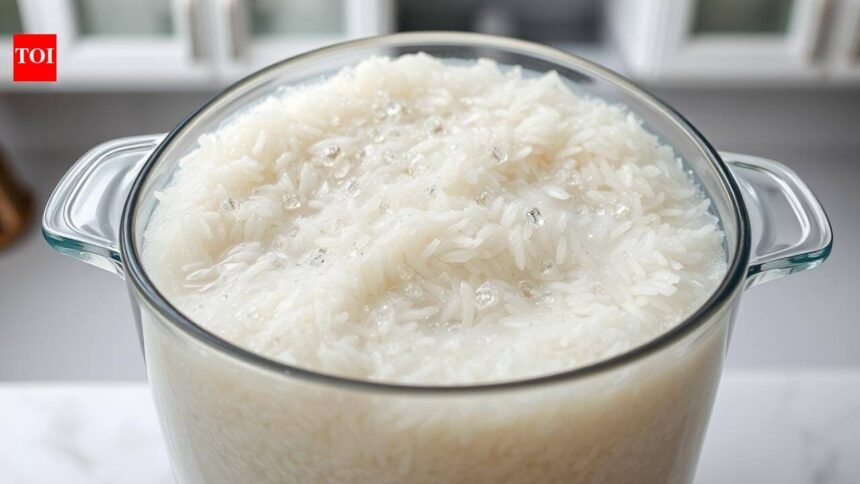

Among other things in the kitchen that can be annoying at times: you pour the rice, add what looks like the appropriate quantity of water, and expect to have a fluffy, distinctively grainy texture like those you have tasted in the restaurant. But upon opening the pot, you see a gooey and sticky mass or a pot of mush. The problem could either be attributed to poor luck or an inexpensive rice cooker; however, it involves intricate chemistry.It really comes down to the science behind the chemistry within each individual grain of rice. Essentially, a grain of rice is a small package of starch, and when immersed in water, it reacts on its own. This is why there may be variations in your cooking time depending on how much water is used with respect to each rice grain.The molecular battle inside the potIn order to achieve the perfect rice texture, one should understand the reactions between the two types of starch present in every single grain: amylose and amylopectin. While the first type adds firmness and prevents sticking, the latter acts as a binding agent. As soon as the rice starts cooking, the starch molecules start leaking into the water and creating a thin layer responsible for the interaction between the grains after cooking.A study titled The molecular structural features controlling stickiness in cooked rice, published in the journal Scientific Reports, explains that stickiness is specifically linked to the size and amount of amylopectin that leaks out during the boiling process. The researchers found that when the leached starch has a larger molecular size and more short branches, the rice becomes significantly more adhesive. This means that even if you use the same amount of water, different rice varieties will respond differently based on their internal starch makeup.
Rinsing rice removes surface starch, while the precise water-to-rice ratio controls internal starch gelation and grain texture for that ideal, distinctively grainy result.
This is exactly why rinsing your rice makes such a difference. When you wash away any excess starch on the surface before cooking it at all, you’re taking out of the equation the substance needed to give you a clumpy mess of rice. And even after you rinse the rice, it’s the water-to-rice ratio that decides whether the internal starch stays in place or turns into gel during soaking.The reasons why the water ratio determines the rice textureMany people tend to follow the same ratio of two-to-one for water and rice in all their dishes, but this one-size-fits-all solution can be detrimental to proper cooking. Water affects not only how hydrated your rice becomes but also how the molecules move while it’s cooling down – this is what’s called retrogradation.One scientific publication in the International Journal of Biological Macromolecules investigates the impact of the water-to-rice ratio on the molecular properties of starch during the process of cooking. The authors prove that the quantity of water regulates the gelation of starch granules. When the ratio of water exceeds optimal values, the rice grains swell considerably, while the starch becomes more mobile and leaches. As a result, the texture of the product becomes more sticky. However, higher quantities of water slow down starch crystallisation during cooling and, hence, preserve the mushy structure for longer periods.According to scientists, the analysis of quasi-elastic neutron scattering demonstrates that increased amounts of water lead to the enhanced mobility of starch molecules. In other words, the excessive quantity of water not only makes rice grains soggy; it inhibits the formation of crystalline networks of starch molecules. To avoid this problem, professional cooks apply the absorption method of rice preparation, using specific portions of water depending on the type of grain and amylose content.Ultimately, it all boils down to the stickiness of the rice kernels. This characteristic is brought about by the presence of starch, which flows out, and the water-to-rice proportion is what controls it. Once you have understood this, you have solved the mystery of preparing that perfect meal. You should add a lesser quantity of water for drier and fluffier rice grains.