
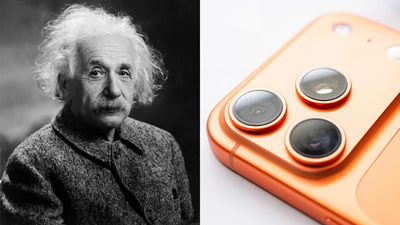

Every time someone snaps a selfie, records a sunset or scans a QR code, they are unknowingly using technology built on a scientific idea once dismissed as strange and almost unbelievable. More than a century ago, Albert Einstein proposed that light behaves not just as a wave, but also as tiny packets of energy capable of knocking electrons loose from materials. At the time, the idea sounded bizarre to many scientists. Yet that same theory, known as the photoelectric effect, would eventually become one of the foundations of modern electronics, helping power solar panels, motion sensors and the smartphone cameras now carried by billions of people worldwide.
The Nobel-winning Einstein theory behind smartphone cameras
At the start of the 20th century, physicists believed light behaved purely as a wave, similar to ripples moving across water. According to classical physics, brighter light should always produce more energy because stronger waves carry more power. But experiments kept producing strange and confusing results.Scientists noticed that certain types of light could trigger electricity when shone onto metal surfaces. Even more puzzling was the fact that the colour of the light mattered far more than its brightness. Weak ultraviolet light could instantly release electrons from a material, while even very bright red light often did nothing at all.This phenomenon became known as the photoelectric effect, and it challenged everything scientists thought they knew about light.In 1905, Albert Einstein proposed a revolutionary explanation. He suggested that light was not just a smooth wave spreading through space. Instead, it also behaved like tiny packets of energy, later called photons. Each photon carried a fixed amount of energy depending on the colour, or frequency, of the light.Imagine trying to knock a ball off a ledge with tiny pebbles. Even thousands of soft pebbles may fail to move it, but one hard rock can knock it off instantly. In the same way, dim ultraviolet light contains high‑energy photons that free electrons immediately, while bright red light contains lower‑energy photons that may still be too weak to do anything.This explained why brightness alone did not matter. A brighter beam simply meant more photons, not stronger ones. What truly mattered was whether each individual photon carried enough energy to release an electron.The idea sounded radical because it contradicted the long-standing belief that light was only a wave. Many scientists initially resisted Einstein’s theory because it seemed too strange to be true. Yet later experiments repeatedly confirmed that he was correct.Today, Einstein is most famous for the theory of relativity, but his Nobel Prize was actually awarded for his work on the photoelectric effect.In 1921, the Nobel Committee recognised his explanation of how light interacts with matter, calling it one of the most important breakthroughs in physics. The discovery later became one of the foundations of quantum mechanics, the branch of science that studies the strange behaviour of particles at atomic and subatomic scales.Einstein built on earlier work by scientists including Heinrich Hertz and Max Planck, but he connected the pieces in a completely new way. His theory helped scientists understand that light could behave both as a wave and as particles, a concept that still shapes modern physics today.
How smartphone cameras rely on the photoelectric effect
Modern smartphone cameras work because camera sensors can convert light into electrical signals. This process depends directly on the photoelectric effect.Most smartphones today use CMOS image sensors, tiny semiconductor chips packed with millions or even billions of light-sensitive pixels. When light enters the camera lens and strikes the silicon inside the sensor, photons release electrons through the photoelectric effect.Those electrons are then measured and converted into digital information. The phone’s software processes that information to create photographs and videos.Without this interaction between photons and electrons, digital photography would not exist.Engineer Eric Fossum, who helped develop CMOS imaging technology at NASA during the 1990s, played a major role in making smartphone cameras practical. Originally designed for space imaging, CMOS sensors eventually became small, efficient and cheap enough to be installed inside billions of mobile phones.Today, nearly every smartphone camera in the world relies on this technology.
The theory that powers everyday life
The photoelectric effect now quietly powers far more than cameras.Solar panels use a related process called the photovoltaic effect to turn sunlight into electricity. Motion detectors and burglar alarms use infrared light sensors that react when a beam of light is interrupted. Automatic doors, rain-sensing windscreen wipers and barcode scanners also rely on light-triggered electrical responses.Even some medical imaging technologies depend on ultra-sensitive sensors built using the same principles Einstein helped explain.One unusual example appeared in 2015, when engineers working on the Raspberry Pi computer discovered that powerful camera flashes could crash the device. Bright xenon flashes triggered the photoelectric effect inside one of the exposed chips, temporarily disrupting the computer’s operation.The incident showed that Einstein’s theory is not just an abstract scientific concept. It is something engineers still have to consider in modern electronics.
The future of light-based technology
Scientists are now developing even more advanced sensors capable of detecting individual photons, the smallest measurable units of light.These ultra-sensitive devices could dramatically improve low-light photography, night vision systems and medical CT scanners while reducing radiation exposure for patients. Researchers are also building flexible light-sensitive materials that may one day help create advanced bionic eyes and wearable medical monitors.Some scientists believe future generations of image sensors could even allow machines to “see” in near-total darkness.While the technology continues evolving, the underlying principle still traces back to Einstein’s 1905 breakthrough.
From bizarre theory to everyday reality
When Einstein first proposed that light came in tiny packets of energy, many physicists viewed the idea with scepticism. Yet over the following decades, experiments repeatedly proved him right.Today, the photoelectric effect sits at the heart of countless modern technologies. It helps generate renewable energy, powers security systems and allows smartphones to capture billions of photographs every day.What was once considered a bizarre theory has quietly become one of the most important scientific ideas behind modern life.