
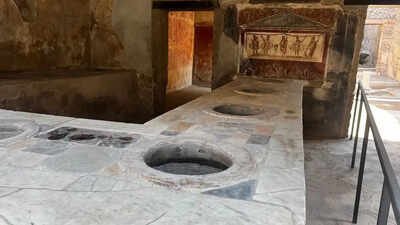

In the ancient ruins of Pompeii, time feels unusually still. Streets, homes, and small shops remain frozen in the aftermath of Mount Vesuvius’ eruption in 79 CE. Among the many discoveries scattered across the site, one of the most puzzling remains a set of ceramic jars built directly into stone counters inside Roman taverns. Archaeologists have studied them for decades, yet their purpose has remained unclear. The jars are physically present, but their story has stayed out of reach. That uncertainty has made them one of the quieter mysteries of everyday Roman life.Now, new research using advanced scanning technology is starting to change how these objects are understood. The answers are still incomplete, but the details being uncovered are beginning to reshape long-held assumptions. The findings suggest that these jars may hold more information about Roman craftsmanship and daily trade than previously believed.
Pompeii tabernae and the mystery of built-in jars that survived nearly 2,000 years
Across Pompeii, archaeologists have identified more than 150 small tavern-style establishments known as tabernae. These were simple one-room shops that served food and drink to locals and travellers. Many of these spaces contain ceramic jars that are permanently fixed into stone counters. These jars vary in size and shape. Some are tall and narrow, reaching nearly three feet in height. Others are shorter and more rounded. They are not removable, and they were clearly built as part of the structure itself rather than added later.For years, researchers could only examine them visually. Opening them was never an option because it would destroy both the vessels and their archaeological context. As a result, their purpose remained uncertain. Scholars have debated whether they stored food, liquids, or something entirely different. No single explanation has been confirmed.
What 3D scans of Pompeii’s jars reveal about Roman craftsmanship
A recent study published in Archaeological Method and Theory used non-invasive scanning technology to investigate the jars. Instead of physically touching or removing them, researchers used handheld light scanners to capture their internal structure. The team analysed around 40 jars from 14 different taverns. They then created detailed 3D models based on the scans. These models allowed them to study the internal shape, alignment, and structural consistency of each vessel.The results revealed that the jars were likely made using a slow-turning potter’s wheel. The process was not fully industrial, but it was also not entirely handmade in a freeform sense. It appears to have been a controlled method that still allowed for small variations during production.
How ancient potters built jars through layered, staged techniques
From the analysis, it can be inferred that the ancient potters used a step-by-step process in making these jars. They would make a portion of the vessel, stop, add new material, and proceed with the process. This resulted in small misalignments of the various portions of each jar. Some of the jars demonstrate high consistency regarding their construction, while others do not. This implies that there were several workshops or potters involved in making them. In some cases, the jars from different taverns display identical shape and construction pattern. This indicates some kind of training among the potters in the area. On the other hand, most of the other jars are significantly different both in terms of their shape and inner structure.
What were these jars used for
Despite all the recent discoveries about the method of making these vessels, their original purpose is yet to be established. Scientists cannot establish exactly what was stored in them. According to some scholars, the contents of the jars might be some cooked food, like stews. This hypothesis is more probable than any liquid because of the fact that they were fixed inside the counter and thus could not be cleaned easily.Nevertheless, there is no chemical evidence proving the above hypothesis. There are other possible uses of the jars that are still under discussion. They can be used for storing semi-solid components or local food items consumed in taverns.