
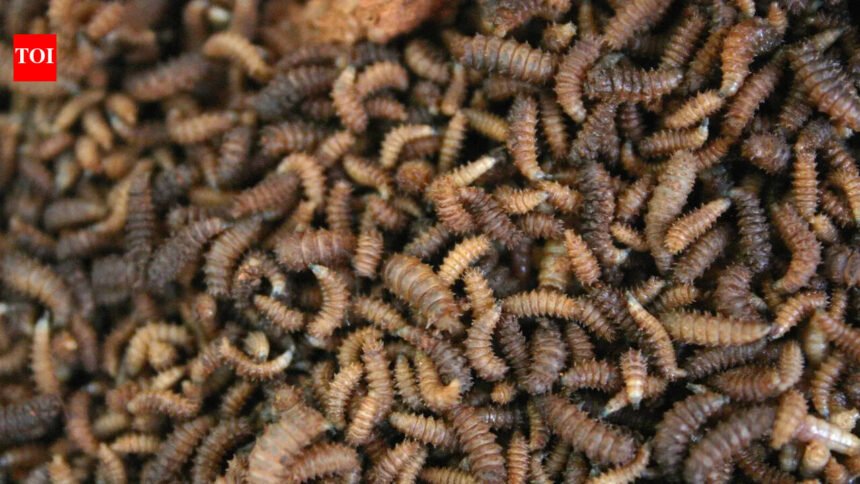

For thousands of years, our understanding of Neanderthals painted them as brute-force hunters, powerful, relentless, and single-mindedly carnivorous. They chased mammoths across frozen plains, brought down bison with coordinated effort, and were ranked by scientists alongside lions and hyenas at the very top of the prehistoric food chain. But a new study is adding a deeply unexpected item to that ancient menu: maggots. Research led by Melanie Beasley, an anthropologist at Purdue University, proposes that Neanderthals and possibly early Homo sapiens as well routinely consumed fly larvae found in stored, decomposing animal fat and flesh, and that this habit may explain some of the most puzzling data in Neanderthal dietary science.
What Nitrogen-15 in Neanderthal bones revealed about their diet
Nitrogen isotopes extracted from Neanderthal remains found across Europe consistently showed elevated Nitrogen-15 values as high as, or in some cases higher than, those of wolves and hyenas. In the science of diet reconstruction, Nitrogen-15 works like a dietary fingerprint. It accumulates progressively through the food chain: plants have very little of it, herbivores absorb moderate amounts, and carnivores accumulate the most. High Nitrogen-15, in theory, means a diet dominated by meat.The problem is that humans, even prehistoric ones, cannot sustain a hypercarnivore diet without serious consequences. Consuming protein at the levels suggested by those isotope values would risk a dangerous condition historically known as “rabbit starvation,” or protein poisoning, where the body is overwhelmed by lean protein with insufficient fat to process it. If Neanderthals truly ate like hyenas, they would have been killing themselves in the process.
The Arctic connection that pointed researchers toward maggots and Neanderthals
So researchers began asking a different question: what else could drive those nitrogen values so high? The answer came from an unlikely direction. Some Indigenous communities from Arctic and subarctic regions are known to eat maggots harvested from putrefied meat, a practice considered not merely tolerable but nutritionally valuable. Beasley began investigating whether fly larvae could be the missing variable in Neanderthal isotope data. What she found was striking. Maggots feeding on decomposing meat carry Nitrogen-15 levels nearly four times higher than those found in lions, making them one of the most nitrogen-enriched food sources imaginable. Consuming even a modest quantity of maggots alongside partially rotted meat could send isotope levels soaring, without requiring a protein-heavy diet that would cause physiological harm.
What decomposing flesh revealed about maggots and Nitrogen-15
To put it to a rigorous test, the researchers analysed fly larvae that had been feeding on decomposing human muscle tissue. As flesh breaks down, lighter nitrogen atoms escape into the atmosphere as gases, leaving heavier Nitrogen-15 concentrated in the remaining tissue. Maggots feeding on this enriched material absorb those heavy isotopes in abundance. Larvae collected during winter months showed even higher values, likely because colder temperatures slow the decay process and allow further nitrogen concentration over time.
Neanderthals and early humans may have used maggots for survival
The implications extend well beyond one species. Prehistoric Homo sapiens showed a similar nitrogen isotope signature, raising the possibility that consuming insects from ageing or stored meat was a widespread adaptive behaviour across multiple hominin groups, not an aberration, but a strategy.Viewed through the lens of survival rather than modern disgust, it is a remarkably sensible one. Maggots are rich in fat and protein, require no tools or hunting skills to collect, and appear naturally wherever meat is stored or left to age. In the brutal conditions of Ice Age Europe, tolerating or even seeking out larvae-infested meat would have been a meaningful nutritional edge.The research team concluded that the elevated nitrogen values in Eurasian Late Pleistocene hominins most likely reflect the routine consumption of stored decomposing fatty animal substrates laced with highly nitrogen-enriched maggots. The study was published in Science Advances.The maggot theory doesn’t make Neanderthals seem more primitive. It makes them seem more human, adaptive, resourceful, and pragmatic in their relationship with food. Willing, above all, to eat what worked.