
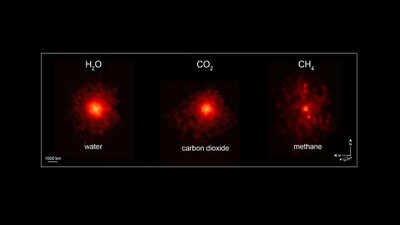

The view coming back from NASA’s James Webb Space Telescope has a way of turning familiar categories of comet science slightly awkward. 3I/ATLAS, an interstellar object only briefly passing through the solar system, has been watched before, but this time the reading feels less like a routine update and more like a chemical surprise that refuses to sit neatly alongside local comets. The data comes from a narrow post-perihelion window, when the object was already receding from the Sun and slowly cooling again. What the telescope picked up was not just the usual mix of water vapour and dust, but signs of gases behaving in ways that do not quite match the established patterns seen in home-grown icy bodies. There is a sense in the numbers that this traveller was built somewhere else, under different conditions entirely.
NASA James Webb Space Telescope observations reveal methane hidden inside an interstellar comet
The comet was observed twice in mid to late December, during a phase when it had already swung past the Sun and was moving back into colder space. At that point, it was still releasing material, though not evenly. The readings suggest a body gradually switching down rather than shutting off in one go.Distances from the Sun were still large in everyday terms, but close enough for solar heating to continue disturbing its surface layers. The instruments tracked that shift in real time, watching how different gases responded as the object drifted farther away. One of the more striking elements in the data is the presence of methane. It was picked up directly in the mid-infrared spectrum, something that had not been clearly recorded for an interstellar comet before. Methane is the sort of compound that does not linger patiently in exposed conditions. It turns from ice into gas at relatively low temperatures, which normally means it should be among the first substances to disappear from a warmed surface.Its appearance here, and the timing of it suggest it may have been tucked below the outer crust. Only when the heat reached deeper layers did it begin to leak out. That kind of delayed release hints at a layered structure rather than a uniform icy block.
PC: NASA
NASA Webb data shows carbon dioxide dominance and uneven gas decline in 3I/ATLAS
Alongside methane, carbon dioxide stood out as unusually dominant. The comet seems to be releasing it at levels that exceed what is typically seen in many solar system comets, especially when compared against water output.That imbalance matters because it points to a different starting composition. Carbon dioxide behaves differently from water ice under heating, and a body that produces more of it relative to water may have formed under colder or chemically distinct conditions than those that shaped objects in our own outer solar system. As 3I/ATLAS moved further away from the Sun, the activity dropped off in a fairly clear pattern. Water production declined most sharply, which is not unexpected, since it tends to require sustained heat to keep sublimating once the surface cools.Methane and carbon dioxide followed their own quieter decline. The overall impression is not of a sudden stop but a staggered retreat, with different materials ceasing activity at different thresholds. The comet does not behave like a single homogenous object losing energy evenly; it reacts in layers, almost as if its interior remembers heat differently from its surface.
What NASA James Webb MIRI reveals about interstellar comet 3I/ATLAS chemistry
The instrument behind these measurements, MIRI on the James Webb Space Telescope, works by breaking infrared light into finely spaced components. Each patch of sky produces not just an image but a full chemical breakdown, point by point, around the comet’s nucleus.That kind of mapping allows faint gases to be tracked as they drift away from the surface, forming a loose envelope around the object. It is less about a snapshot and more about a moving chemical field, shifting as sunlight weakens and distance increases. What builds up from the combined readings is not a dramatic anomaly so much as a persistent mismatch. The ratios are off in small but noticeable ways. Methane appears later than expected. Carbon dioxide dominates more than usual. Water fades faster than the rest.