
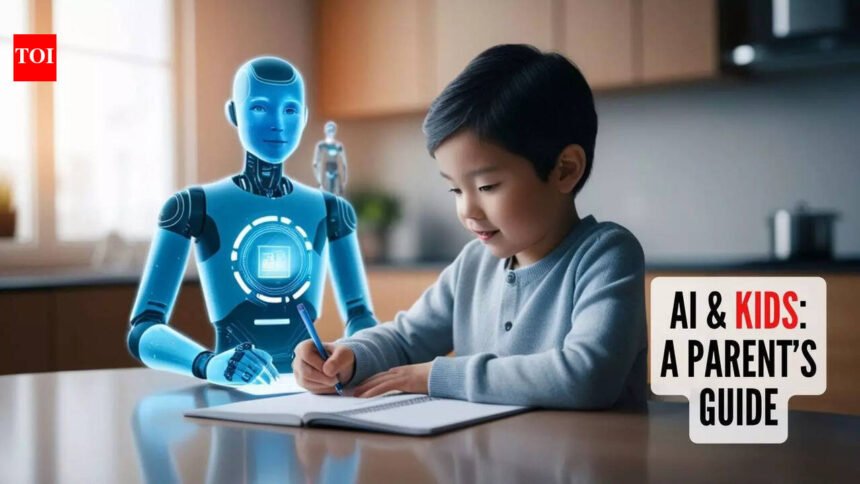

Artificial intelligence is no longer a distant idea. It sits in living rooms as smart speakers, cleans floors as robot vacuums, and answers homework questions in seconds. Children are meeting AI earlier than many adults did. Some feel curious. Others feel unsure. Many parents feel both at once. The real question is not whether children will encounter AI. They already have. The question is how families can shape that encounter with clarity instead of fear. Here is how parents can begin.
Start with curiosity, not caution
Children notice AI before adults start the conversation. A smart assistant answers a question. A video app suggests the next cartoon. A chatbot replies instantly. According to UNICEF, conversations about AI can begin quite early. Ying Xu, Assistant Professor of AI in Learning and Education at Harvard University, explains that even preschoolers can understand simple ideas about what AI can and cannot do.When a child asks, “How did it know that?” that moment is enough. Instead of saying, “It’s complicated,” a parent can say, “It follows patterns and instructions, but it does not think like people do.” That single sentence removes mystery. And mystery is often what creates fear. Children are less afraid of what they understand.
Explain AI through everyday objects
Young children learn best through what they can see and touch. A robot vacuum follows a path. A phone unlocks with a face scan. A music app suggests songs. These are practical examples of AI.Ying Xu’s research shows that children grasp AI more easily when it connects to daily life. Exploring together helps. If a child types a question into a chatbot, look at the answer together. Ask simple questions:
- Does this answer make sense?
- Is anything missing?
- Could it be wrong?
This teaches something deeper than technology. It teaches judgment. AI does not “know.” It predicts based on data. Once children understand that, they stop seeing it as magical. They start seeing it as a tool. And tools can be guided.
Use AI to support learning, not replace it
AI can explain maths steps, summarise chapters, and offer language practice. Research in education shows that well-designed AI tutoring systems can help students learn specific skills effectively. But there is a line.A study published in the journal Societies also show that students sometimes offload their thinking to AI. They may stop struggling through a problem. Yet struggle is not failure. It is how memory forms. Some teenagers themselves admit that too much AI help weakens their confidence in solving problems alone. That insight matters. Children know when something feels too easy. Parents can frame AI as a practice partner, not a shortcut. For example:
- Try solving first.
- Use AI to check.
- Compare answers.
This builds independence instead of dependence.
Teach privacy as a life skill
AI tools collect information. Sometimes it is basic data like age or email. Sometimes it includes deeply personal questions about feelings, friendships or health.Children do not always recognise what counts as sensitive. A home address feels private. But talking about anxiety or family conflict with a chatbot can also reveal personal information. UNICEF recommends minimal and purpose-specific data collection for children’s protection. Families can mirror that principle at home:
- Review privacy settings together.
- Discuss what should not be shared.
- Pause before typing personal details.
Privacy conversations should not sound like warnings. They should feel like preparation. A child who understands digital boundaries grows into an adult who respects them.
Watch for emotional substitution
Some children find it easier to talk to AI than to people. AI responds quickly. It does not argue. It agrees. That can feel comforting.But real relationships include disagreement, compromise and emotion. If AI becomes a child’s main source of reassurance, something may be missing elsewhere.Warning signs include:
- Long hours of AI conversations.
- Irritation when asked to stop.
- Reduced interest in friends or hobbies.
The response should not be punishment. It should be conversation. Asking what feels helpful about the tool often reveals deeper needs. Sometimes the issue is not AI. It is loneliness, school stress or social pressure. AI becomes a mirror. Parents just need to look into it carefully.
Approach AI as co-learners
Many adults feel behind. AI evolves quickly. New tools appear every month.Ying Xu suggests shifting away from the idea that parents must be experts. Right now, adults and children are often learning at the same pace. Exploring together changes the tone of the relationship. Instead of control, there is collaboration.Parents can also rely on external guidance. Organisations like Common Sense Media now provide ratings for certain AI tools. Some schools publish lists of approved educational apps. These vetted spaces can serve as safer starting points. When children see adults learning calmly, they absorb that calm. Confidence spreads quietly inside families.AI is powerful. But it is not the centre of a child’s development. Relationships, routines, physical activity and face-to-face conversations shape growth far more deeply than any algorithm. AI becomes helpful or harmful depending on the environment around it. The goal is not to remove AI from childhood. The goal is to place it in proportion. Technology should serve the child. The child should not serve the technology.Disclaimer: This article is intended for educational purposes. Technology platforms, data practices and school policies may change over time. Parents are encouraged to review official guidelines from trusted institutions such as UNICEF, consult school policies, and seek professional advice when needed.