
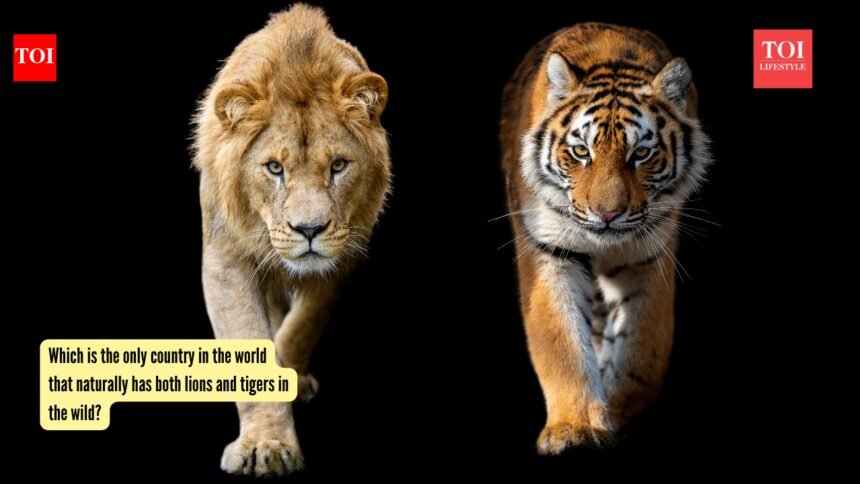

The lion and tiger are two among the most regal big cats. While on id the king of the jungle, the other is impeccably powerful and the national animal of India.We tend to imagine them in completely separate worlds, like the lions who mostly live in the open plains of Africa, and the tigers deep in the forests of Asia.While mostly this criterion is correct. But there is one country where both of these magnificent animals roam free in the wild, and it might not be the one you would first guess.That country is India. It is a quietly an interesting fact, although it might sound too true to be true, and yet it is.No other nation on the planet is home to wild populations of both lions and tigers at the same time. It is one of the most interesting facts that India has held for generations, and it says a great deal about the country’s diverse landscapes and its long, hard-won conservation work.
Representative Image (Photo: Canva)
India is the only home to both lions and tigers
India is a unique place in the world’s natural heritage. It is the only country where lions and tigers both live in the wild. It is home to the Asiatic lion, found mainly in and around Gir National Park in Gujarat, and the Bengal tiger, spread across more than 50 tiger reserves nationwide. No other nation can claim the same. The secret lies in India’s variety of habitats, from the dry western forests of Gir to the dense eastern mangroves of the Sundarbans, where each suits a different cat.
Where are the Asiatic lions found in India
The Asiatic lion is a bit smaller than its African cousin but every bit as majestic. Today, it survives in the wild in just one place on Earth, the Gir forest of Gujarat. Once, these lions were found all across from the Mediterranean to India, before hunting and habitat loss pushed them to the brink.
Where is the Bengal tiger found in India?
The Bengal tiger is India’s national animal and the world’s most numerous tiger subspecies. They are found in famous reserves like the Sundarbans in West Bengal, Ranthambore in Rajasthan, Bandhavgarh in Madhya Pradesh, and Jim Corbett in Uttarakhand. India is the global stronghold for the species by a wide margin. According to the Ministry of Environment, Forest and Climate Change, the 2022 census estimated 3,682 tigers in the country, making India home to roughly 75% of all the wild tigers left in the world.
So, do the two big cats ever cross paths with each other?
Although they share one country, India’s lions and tigers never actually meet in the wild. They are kept apart by hundreds of kilometres and by very different terrain. The Asiatic lions stay within Gujarat’s dry, scrubby forests in the west, while Bengal tigers roam forests, grasslands, and mangroves scattered across many other states. Their ranges do not overlap, so even though it is thrilling that one nation hosts both, we will never witness a lion and a tiger sharing the same patch of jungle. However, it was not always this way. A historical study titled “Clash of the Titans,” published in the Journal of the Bombay Natural History Society, points out that in the past, the Asiatic lion and the Bengal tiger actually had overlapping ranges across large parts of southern Asia. “As per Gauss’s exclusion principle, two sympatric species that compete for the same resources cannot coexist in a stable manner and one will eventually outcompete the other (Hardin 1960). But just a century or two earlier, the two biggest extant felid species i.e., the lion (Panthera leo) and the tiger (Panthera tigris) had overlapping geographical distributional ranges through much of Western, Central and Southern Asia”, said the study.Based on records from 19th-century British India, when British observers documented the two cats living side by side, the study suggests they likely ran into each other quite often, usually where tropical dry deciduous forests met thorn forests, and that lions probably came out on top in most of these clashes. In fact, it concludes that lions and tigers coexisted in the Indian subcontinent for at least 10,000 years, their long coexistence was more dependant on their different ways of living than by any constant fight to the death.
A few facts that might surprise you
A few details make this story even more striking. The Asiatic lion exists in the wild nowhere else on Earth, making Gir its last refuge. Lions also once roamed widely across parts of Europe and Asia before disappearing from almost all of it. And both animals are woven into India’s identity as the lion is shown in the national emblem, drawn from the Lion Capital of Ashoka, while the tiger, as the national animal, stands for power, pride, and the wild itself.