
Font ResizerAa
The Popular StoryThe Popular Story
  • Lifestyle
  • Sports
  • Entertainment
  • News
  • World
Search
  • Lifestyle
  • Sports
  • Entertainment
  • News
  • World
Follow US
Copyright © 2024 MP Media. All Rights Reserved.
The Popular Story > Blog > World > Ecuadorian artisans working to preserve the traditional craft of weaving horsehair strainers
World

Ecuadorian artisans working to preserve the traditional craft of weaving horsehair strainers

By Mohit Patel Last updated: June 9, 2026 3 Min Read
Share


Ecuadorian artisans working to preserve the traditional craft of weaving horsehair strainers

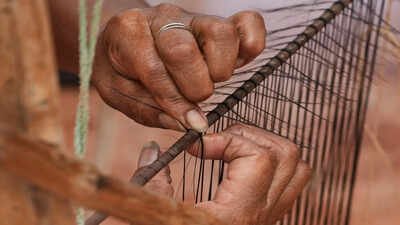
In her modest home in Guangopolo, east of Ecuador’s capital, Ligia Ipiales carefully separates strands from a horse’s tail, weaving a mesh as fine as gauze for a “cedazo,” a traditional sieve clinging to survival.The craft that once made the village famous is now fading. Only nine “cedacero” artisans remain. The youngest is 51-year-old Guido Paucar, the only man in the group, while the oldest is Ipiales, at 76.“This is our village’s identity. If it disappears, Guangopolo loses a part of who it is,” said Paucar. “We are the last generation making these sieves.”Fifty years ago, recalled Paucar, around 500 Indigenous families made a living by crafting and selling sieves, moving up to 600 units every month, with prices ranging from $6 to $30 depending on the size. But the emergence of cheaper plastic sieves and synthetic fabrics meant that sieves were reduced to display crafts with no presence in everyday life. “Now we only sell up to 10 each week,” he added.Local records show that 1,500 residents of Guangopolo have been weaving sieves for 200 years. Crafted like a drum, each sieve features a thin, 15-centimeter (6 inches) high wooden rim that secures the traditional horsetail fabric. Until the turn of the past century, the tools were indispensable in Ecuadorian kitchens, where they were primarily used to sift flour.Industrial growth and environmental shifts have made it increasingly difficult to source horsehair and the wood of the native Pumamaqui tree.Until recently, horses were indispensable companions for agricultural work in the Andean fields. Today, however, farmers prefer motorcycles and tractors. This shift has forced artisans to look elsewhere, making southern Colombia and central Ecuador the primary sources for horsehair. But the material comes at a steep price, with 100 pounds (about 45 kilograms) costing around $1,000.After being washed and dried, horsehair is sorted by length and stretched onto a simple wooden frame known as a guanga. Seated cross-legged on the floor, the artisans work with such speed that their fingers blur, selecting, stretching and knotting individual strands into an intricate mesh.Making cedazos once provided women with extra income and sometimes helped pay for their children’s education.At the El Cedacero craft center, home to Guangopolo’s remaining weavers, efforts to train a new generation through workshops and classes have repeatedly fallen short.“From the age of 6 or 7 our mothers taught us how to weave sieves,” said Leonor Cuje, 57, gesturing toward a table lined with sieves, bracelets and brushes made from horsehair. “Now they are professionals and they don’t want to do this anymore.”



Source link

Sign Up For Daily Newsletter

Be keep up! Get the latest breaking news delivered straight to your inbox.
[mc4wp_form]
By signing up, you agree to our Terms of Use and acknowledge the data practices in our Privacy Policy. You may unsubscribe at any time.
Share This Article
Facebook Twitter Email Copy Link Print
Leave a comment Leave a comment

Leave a Reply Cancel reply

Your email address will not be published. Required fields are marked *

SUBSCRIBE NOW

Subscribe to our newsletter to get our newest articles instantly!

[mc4wp_form]

HOT NEWS

6 social etiquettes every child should be taught and 6 reasons they can benefit a child’s future

True social etiquettes are more than table manners or polite greetings. It’s about understanding that…

June 9, 2026

Mohit Patel: The Visionary Mind Behind MP Media, Monax, and The Popular Story

In the competitive era of digital media, branding, and youth culture, very few names are…

April 23, 2025

At AI Summit, PM Modi’s nameplate carries a ‘Bharat’ message | India News

NEW DELHI: Prime Minister Narendra Modi on Thursday addressed the plenary session at the AI…

February 19, 2026

YOU MAY ALSO LIKE

UAE-based Nepali security guard wins Dh30m lottery jackpot with 4 friends; plans new home for family | World News

A Nepali security guard living in Abu Dhabi has become the first winner of The UAE Lottery's Lucky Day grand…

World
June 9, 2026

More than bones: German students buried their classroom skeleton after discovering it was a real person, likely from India | World News

A coffin carrying the remains of a woman whose name nobody knew was lowered into the ground in western Germany…

World
June 9, 2026

The sheep-killer myth that helped drive the Tasmanian tiger to extinction and why scientists think farmers got it wrong |

For decades, the Tasmanian tiger was portrayed as Australia's most feared livestock predator. Farmers blamed it for dead sheep, newspapers…

World
June 9, 2026

Wildlife miracle: Tiny Michigan town saved an entire bird species and rewrote conservation history |

At first glance, Mio looks like countless other small towns scattered across rural America. Fewer than 2,000 people live here…

World
June 9, 2026
Copyright © 2020 MP Media All rights reserved.
Welcome Back!

Sign in to your account

Lost your password?