
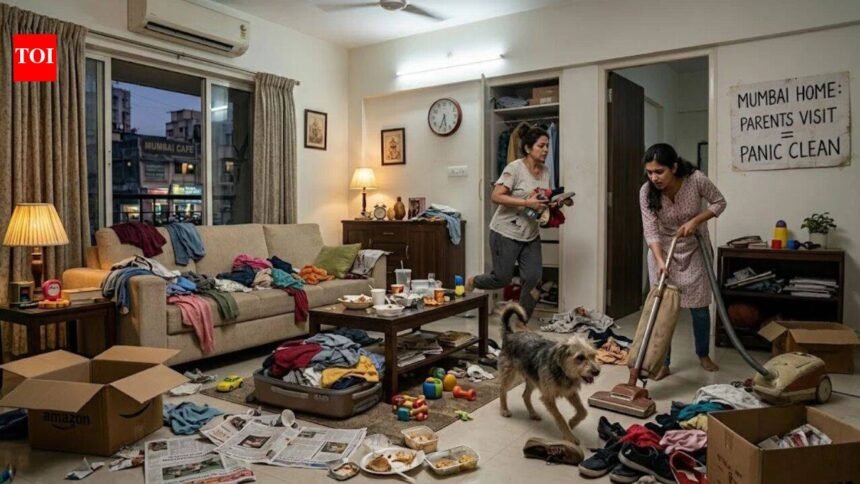

The message is simple: “We’re coming over tomorrow.” Suddenly, the coffee mug that has been sitting on the table for two days becomes unacceptable. The laundry pile needs to disappear, the bathroom mirror needs cleaning, and even the shoes near the door start looking embarrassing. For many adults, this familiar panic-cleaning routine may seem like a simple attempt to make the house presentable. But psychology suggests that there can be more going on. The arrival of parents can turn an ordinary home into a space where people become more conscious of how they might be judged. Research on personal spaces, impression formation and housekeeping suggests that our surroundings can influence how others perceive us. This may help explain why someone who happily lives with a little clutter suddenly wants every corner of the house to look perfect before their parents arrive.
Your home can become a reflection of who you are
22 Sept 2026 | 14:56
Does your child tell you everything about school? What helps them open up?
Psychologist Samuel Gosling and his colleagues have studied how people form impressions of others by looking at personal environments such as bedrooms and offices. Their research found that people use visible cues in these spaces to make judgments about the personalities, values and lifestyles of the people who occupy them. Some of those impressions can even be accurate. hat makes the state of your home psychologically interesting. A bookshelf, photographs, decorations, belongings and the way things are arranged can all communicate something about the person living there. So when parents announce a visit, a messy kitchen may suddenly feel like more than a messy kitchen.It can feel like evidence. An adult who normally thinks, “I’ll clean it later,” may suddenly worry that their parents will see the clutter and interpret it as a sign that they are disorganised or not managing life properly. This is where the idea of impression management becomes relevant. People often care about how they are perceived by important people in their lives. Cleaning before a parental visit can therefore become a way of communicating something without actually saying it: “I’m doing fine. I’m responsible. I have my life under control.” The person may not consciously think this way. Yet the desire to create a particular impression can still influence their behaviour.
Why parents can make the cleaning feel more urgent
There is evidence that cleanliness can affect the impressions people form about others. In a study published in the journal Environment and Behaviour, psychologists Paul B. Harris and Daniel Sachau examined how descriptions of an apartment being clean or dirty affected perceptions of its resident. The study involved 336 undergraduate participants. Residents described as poor housekeepers received lower ratings on several characteristics, including conscientiousness and agreeableness. The researchers concluded that housekeeping can serve as a cue when people form impressions of others. That does not mean a messy home proves that someone is irresponsible. It simply shows that people can use environmental cues when forming opinions.For adults, parents can be a particularly powerful audience because they have known them for much longer than most friends or colleagues. A colleague may see someone as a successful professional. A parent may also remember the teenager who needed constant reminders to clean their bedroom. That history can make a parental visit feel different. The adult may want their home to communicate a new identity: that they are capable, independent and responsible. Cleaning can become a simple, visible way of reinforcing that identity.
The mess may also feel more important because someone is watching
The interesting part is that the house itself has not necessarily changed. What has changed is the presence of an imagined observer. Before the phone call, the shoes near the door were harmless. After hearing that Mom and Dad are coming, the same shoes suddenly become something that needs to be moved. This can also explain why cleaning may feel strangely satisfying before an important visit. There are parts of the visit that cannot be controlled. You cannot control exactly what your parents will notice, what questions they will ask or what they might say. But you can control the living room. Vacuuming, arranging cushions, clearing the kitchen and putting away laundry turn an uncertain social situation into a list of concrete tasks. Cleaning can therefore provide a sense of control while reducing the worry about being evaluated.Family habits can add another layer. Someone raised in a home where everything was cleaned before guests arrived may automatically repeat the routine as an adult. Over time, parental expectations can become personal standards. Still, panic-cleaning does not automatically indicate anxiety, insecurity or controlling parents. People may clean because they value hospitality, want visitors to feel comfortable or simply prefer their home to look presentable. What psychology suggests is more subtle: when someone important enters our private space, that space can start feeling like a reflection of us. And when the visitors are the people who once told us to clean our rooms, a little last-minute panic may suddenly make perfect sense.