
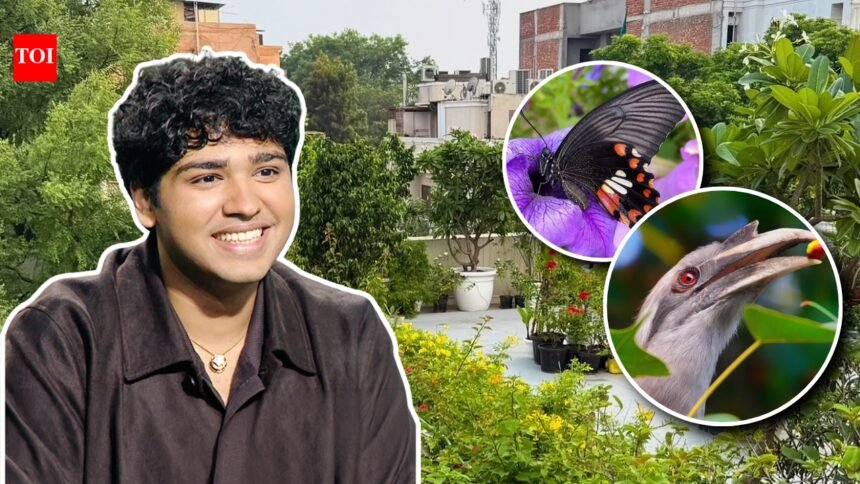

For Aman Sharma, the idea of bringing wildlife home began with a problem that many nature lovers faced during the Covid-19 lockdown: he could no longer go out looking for it.A wildlife photographer who had been going on wildlife trips since he was 14, Sharma found himself confined to home. Instead of waiting to return to the forests, he began looking at the space he already had – his terrace in Delhi.Over time, the once-bare terrace turned into what he describes as an urban jungle, with more than 500 plants. It has also become a place where he has observed more than 100 kinds of birds and over 25 kinds of butterflies.But Sharma’s experiment offers a lesson beyond his own terrace. He believes people do not need a large garden to make their homes more useful to urban wildlife. A balcony, window or small terrace can begin with just a few carefully chosen plants.“On this terrace, we have planted more than 500 plants. Because of that, we have seen more than 100 types of birds and more than 25 types of butterflies in Delhi,” Sharma told Indicore.His formula is simple: don’t just plant whatever looks good. Think about what different species need.“If you plant three types of plants, your home can also become an urban jungle,” he says.
Start with a host plant
The first category Sharma recommends is host plants – plants that butterflies can use as part of their life cycle.“First – host plants, for example, lemon,” he says.The point, he explains, is to create a space that supports wildlife rather than merely attracting it for a short time. A butterfly-friendly terrace, therefore, needs plants that can actually serve a purpose beyond providing flowers.This is one reason Sharma’s approach is different from simply filling a balcony with ornamental plants. The aim is to create several kinds of resources in the same space.
Add flowering plants
The second category is flowering plants.“Second: flowering plants – sadabahar, bougainvillea,” Sharma says.Flowering plants can make a terrace more inviting to pollinators while also adding another layer to an urban garden.But Sharma’s own terrace did not become an urban jungle in one go. It was built gradually, through experimentation and observation.His 2020 rewilding project was also reported by The New Indian Express, which described how he used indigenous plants and a mix of flowering and fruit-bearing species on his terrace to attract birds, bees and butterflies.
Sharma recommends host, flowering and food-bearing plants to attract wildlife.
Plant for birds too
The third part of Sharma’s approach is to grow plants that can provide food for birds.“Third: plants on which birds come and eat – chikoo, capsicum, pomegranate, brinjal and guava,” he says.That means a terrace can combine plants serving different purposes: some for butterflies, some for flowers and pollinators, and others that can provide food for birds.The result is not necessarily a manicured garden. It is a space with different kinds of plants doing different jobs.For Sharma, that is what makes the idea replicable.
His love for birds started young
The terrace project is an extension of an interest Sharma developed much earlier.He has described how his fascination with birds grew into wildlife photography and conservation work. In an interview with The New Indian Express, he recalled becoming interested in birdwatching as a young teenager after watching a bulbul build a nest in his balcony. He later began photographing birds and documenting the wildlife that exists within Delhi.His experience of observing wildlife outside the city eventually made him look more closely at wildlife within it.Then came the lockdown.Unable to travel to forests and wildlife destinations, he began experimenting with his own terrace. What started as a way of staying connected to nature gradually became a larger exercise in creating habitat at home.
Aman Sharma is a wildlife photographer and birdwatcher.
“If I can’t go to the birds, I’ll make the birds come to me”
The idea has since grown beyond Sharma’s own home. Speaking on KBC, he suggested that the same principle could work across thousands of ordinary Indian homes. “If every person, whether they have a balcony, terrace or window, plants two to three host plants, then for butterflies across India, we can create a wildlife corridor – for migration,” he said.“If everyone’s homes become like this, I think, for me, the world would change.”The important part of that idea is its scale. One balcony cannot recreate a forest. But thousands of balconies, terraces and windows with plants that support insects and birds could create a network of small green spaces across a city.Sharma’s own experience suggests that people can start without trying to replicate a 500-plant terrace. Begin with a host plant. Add a flowering plant. Then consider a fruit- or food-bearing plant that birds can use.The terrace that began as a way for a young wildlife photographer to stay connected with nature during lockdown has consequently become a practical example of a larger idea: urban wildlife does not always need a forest to begin with. Sometimes, it can begin with a few pots outside a window.