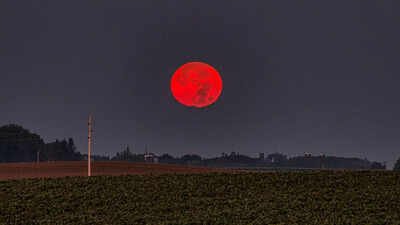

It can be very dramatic when the Moon slowly gets darker and then turns a deep red. People have been afraid of this sight for hundreds of years. A lot of old cultures thought it was a sign of bad things to come. Science gives a clear answer today. The red Moon, which is often called a “Blood Moon,” is not a mystery or a sign from God. It is a well-known and expected effect of how sunlight interacts with the Earth’s atmosphere during a total lunar eclipse.One of the few astronomical events that can be safely watched without special equipment is a total lunar eclipse. But even though you can see it with your eyes, the physics behind it is amazing. The Moon doesn’t make its own light. It shines because it bounces sunlight off of it. Something strange happens when Earth moves directly between the Moon and the Sun. The Moon doesn’t go away completely; instead, it glows red. The reason is the way shadows, light scattering, and the makeup of our atmosphere work.
What is a total lunar eclipse
A lunar eclipse occurs when Earth moves between the Sun and the Moon, blocking sunlight from directly reaching the Moon. According to NASA, this alignment can only happen during a full Moon.There are three types of lunar eclipses:
- Penumbral lunar eclipse
- Partial lunar eclipse
- Total lunar eclipse
A Blood Moon happens only during a total lunar eclipse, when the Moon passes completely into the darkest part of Earth’s shadow, called the umbra.Lunar eclipses usually occur between zero and three times in a year, though in rare cases there can be more. However, not every lunar eclipse is total.
How does Earth block the Sun
When Earth positions itself directly between the Sun and the Moon, it casts a large shadow into space. This shadow has two main parts:
- Penumbral shadow: The outer, lighter shadow
- Umbra: The inner, darkest shadow
During a total lunar eclipse, the Moon enters the umbra. At this point, direct sunlight is blocked. Logically, one might expect the Moon to turn completely black. But it does not. Instead, it appears red or orange.According to the European Space Agency, this happens because Earth’s atmosphere bends and filters sunlight before it reaches the Moon.
The science behind the Moon turning red during total lunar eclipse
The light from the sun looks white, but it is made up of many colours. The wavelengths of these colours are different. Light in the blue and violet ranges has shorter wavelengths, while light in the red and orange ranges has longer wavelengths.When sunlight hits the Earth’s atmosphere, the shorter wavelengths spread out in all directions. Rayleigh scattering is the name of this process. The same thing makes the sky look blue during the day.According to NASA, blue and violet light scatter more easily when they hit air molecules. Red and orange light have longer wavelengths, so it goes through the atmosphere more easily.When there is a total lunar eclipse, sunlight goes through the edges of Earth’s atmosphere before reaching the Moon. As the light goes through this thick layer of air:
- Blue light gets scattered away
- The red and orange lights keep moving.
- The atmosphere of Earth acts like a lens, which makes the red light bend a little.
Most of the blue light is gone by the time this light reaches the Moon. Most of what is left is red light that bounces off the Moon’s surface and comes back to Earth. That is why the Moon looks red.
Why is it called a “Blood Moon”
The term “Blood Moon” is not a scientific term. It is a popular name used to describe the reddish colour of the Moon during a total lunar eclipse.According to reports, the exact shade of red can vary. Sometimes the Moon looks coppery orange. At other times, it appears deep red or even dark brown.The variation depends largely on conditions in Earth’s atmosphere at the time of the eclipse.
Why aren’t all Blood Moons equally red
Not every total lunar eclipse looks the same. Some appear bright orange. Others look dark red or even greyish.This difference is mainly due to Earth’s atmospheric conditions. According to NASA, factors that affect the colour include:
- Dust in the atmosphere
- Volcanic ash
- Wildfire smoke
- Air pollution
More particles get into the air when there is a big volcanic eruption or a lot of wildfires. These particles can block or filter sunlight in different ways. The Moon might look darker than usual in some cases.This means that during a total lunar eclipse, the Moon can show what the Earth’s atmosphere is like right now.
What would it look like from the Moon
The view would be very different if someone were standing on the Moon during a total lunar eclipse.They would see the Sun being blocked by Earth. Earth would look like a dark circle with a glowing red ring around it. The ring would be the air around Earth. The red glow is caused by sunlight passing through and bending around the planet.During the eclipse, this ring of light makes the Moon’s surface red.
A planet-sized light show explained by physics
A total lunar eclipse is not rare, but it is always striking. It combines celestial alignment, shadow geometry, and atmospheric physics in one visible event.In simple terms:
- Earth blocks direct sunlight.
- Earth’s atmosphere scatters blue light.
- Red light bends and reaches the Moon.
- The Moon reflects that red light to us.
There is no mystery behind it. The red colour of a Blood Moon is a result of light scattering and atmospheric filtering.The next time the Moon turns red, it will not be a sign of danger. It will be a reminder that even simple sunlight, when filtered through our planet’s atmosphere, can create one of the most dramatic sights in the night sky.