
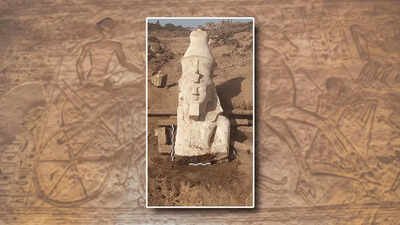
Hidden beneath Egypt’s shifting sands for almost a century, a missing piece of history has quietly returned. Archaeologists working in central Egypt have uncovered the upper section of a colossal seated statue of Ramesses II, one of the country’s most recognisable rulers. The fragment connects to a lower portion discovered in the 1930s, sparking renewed interest in restoring the monument as a single sculpture. Experts say the discovery appears unusually well preserved, with traces of original pigment still clinging to the limestone surface. The broader significance might lie in what it reveals about royal imagery beyond Egypt’s main temple cities. Sometimes archaeology feels like detective work stretched across generations, and this discovery fits that description almost perfectly.
El Ashmunein find reveals pharaoh statue fragment at Hermopolis Magna
The statue fragment was found at El Ashmunein, which sits atop the ruins of the ancient city of Hermopolis Magna.This city once served as a major religious centre dedicated to Thoth, the ibis-headed deity linked to writing and knowledge. Archaeological layers here show continuous occupation across multiple periods, which often complicates excavation work. The newly uncovered piece stands around 12.5 feet tall and depicts the pharaoh seated in a formal pose. Carved from limestone, the statue shows a ceremonial headdress and a partially preserved uraeus cobra, a royal symbol associated with divine kingship.Experts say the craftsmanship suggests a monument intended to project authority far beyond Egypt’s capital regions.
Missing statue piece finally connects to the 1930 discovery
Researchers quickly linked the fragment to a lower statue half discovered in 1930 by German archaeologist Günther Roeder. At the time, Roeder documented the base but found no upper portion. For decades, the statue remained incomplete, a puzzle missing its most expressive element.The recent excavation was led by Basem Gehad from Egypt’s Ministry of Tourism and Antiquities and Yvona Trnka-Amrhein of the University of Colorado Boulder. Their team reportedly uncovered the fragment face down in moist soil while investigating another sector connected to papyrus finds. Measurements and stylistic analysis suggest that both statue parts belong together.
Ancient pigments reveal the statue’s lost vibrancy
Surprising traces of ancient colour. One detail that has captured scholarly attention is the presence of pigment. Researchers identified blue and yellow colouring embedded in the limestone, suggesting parts of the statue once displayed vivid decoration. Most Egyptian sculptures have lost their paint due to erosion and exposure. The fragment’s preservation seems particularly striking given environmental challenges in the region. Changes in groundwater levels following the construction of the Aswan Low Dam have affected archaeological layers at the site, raising concerns about mineral leaching and stone fatigue.
Statue reconstruction proposal
Egyptian authorities have reportedly submitted a proposal to the Supreme Council of Antiquities seeking approval to reassemble the statue. If restoration proceeds, the monument could become one of the tallest seated representations of the pharaoh outside major temple centres such as Abu Simbel, Luxor, and Karnak.Officials have not confirmed whether the restored statue would remain at the discovery site or be relocated to a museum setting.
Why Ramesses II still dominates Egyptian archaeology
Ramesses II ruled from 1279 to 1213 BCE and is widely known for large-scale construction projects, military campaigns, and extensive temple building along the Nile Valley. Placed strategically in regional religious centres, they reinforced royal presence and divine legitimacy far from administrative capitals.Excavations at El Ashmunein are expected to continue through 2026, with teams expanding into nearby sectors using subsurface mapping and stratigraphic analysis. Archaeologists suspect additional fragments from the same statue group might still be buried.