

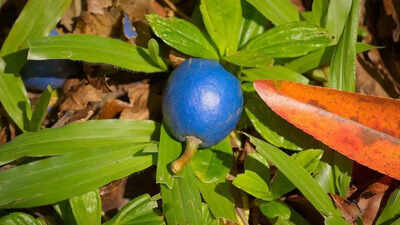
Walk through a tropical rainforest, and you quickly notice a pattern in the fruits growing around you. Most are red, orange, purple, or sometimes nearly black. Blue fruits appear to exist, but botanists often point out that many of them are not truly blue when examined closely. Blueberries, for instance, look blue from a distance but are technically closer to deep purple or indigo. True blue is surprisingly rare in the plant world.Yet deep in the rainforests of Australia and parts of Southeast Asia grows a tree that seems to break that rule entirely. The species, Elaeocarpus angustifolius, is often called the blue quandong, blue fig, or blue marble tree. Its fruit shines with a vivid metallic blue that looks almost unreal in natural sunlight. Many people assume the colour must come from some powerful pigment. Scientists say the truth is far stranger.
The tree that grows a rare blue fruit
The blue quandong tree grows across tropical regions of northern Australia, Papua New Guinea, and parts of Indonesia. It is a tall rainforest tree that can rise well above the surrounding vegetation. When the fruit appears, it often draws attention immediately because of its unusual colour. Each fruit is small and round, usually measuring around one to two centimetres in diameter. The surface is smooth and firm, and the colour is an intense shade of cobalt blue. Even under soft forest light, the fruit can appear to glow.Many people who encounter it for the first time assume the colour has been altered or enhanced somehow. It can resemble polished glass beads scattered across the forest floor. Scientists studying plant colours have even suggested that the blue quandong may display the most intense natural blue colour found anywhere in the plant kingdom.
Why did scientists think the fruit contained blue pigment
Researchers initially assumed the fruit must contain some form of blue pigment. That is how most plants create colour. Pigments absorb certain wavelengths of light and reflect others, producing shades such as red, purple, or yellow. To test this idea, scientists crushed the fruit and attempted to extract the colouring compounds. They expected to see blue liquid appear during the process.The result puzzled researchers because the bright blue colour completely disappeared once the fruit structure was broken apart. That observation hinted that the colour might not come from pigment at all.
The hidden structure that makes the fruit look blue
Further studies have revealed something amazing inside the skin of the fruit. The outer layer of the fruit contains very small structures arranged in the form of repeating microscopic layers. These microscopic layers are made up of a material called cellulose, which is the same material found in the cell walls of a plant.This structure, when viewed through a powerful microscope, resembles a set of plates or thin layers of material with small gaps in between. This structure reflects different wavelengths of light. For instance, in the case of the blue quandong fruit, the structure reflects the wavelengths of blue light best. The white light hitting the fruit surface is then reflected, but this time the reflected light is mainly composed of the color blue. This effect of structural coloration is also found in nature in various other places, for example, the colors found on the surface of butterfly wings, the shells of beetles, and the feathers of a peacock. These colors are not the result of any pigment.
Why would a fruit evolve this colour
Biologists believe the colour may play a role in attracting animals that help spread the tree’s seeds. In tropical forests, many fruits rely on birds to carry seeds away after eating them. Birds have excellent colour vision and can detect a wide range of colours, including wavelengths that humans cannot see easily. A bright blue fruit against a background of green leaves might appear extremely noticeable to them.Researchers studying the species suggest that the rarity of the colour itself could make the fruit stand out more clearly in dense vegetation. The unusual blue surface may function like a signal that tells birds the fruit is ready to eat.When birds consume the fruit, they eventually disperse the seeds through their droppings elsewhere in the forest. That process allows the tree to reproduce and expand into new areas.
Why is this blue fruit so rare in nature
Scientists have identified only a small number of fruits that use structural colouration instead of pigment. The blue quandong is often listed among the most striking examples. The fruit’s colour exists purely because of the physical arrangement of microscopic layers within its skin. When those layers are destroyed, the blue disappears completely. That detail alone reveals how delicate the mechanism is. Nature often relies on chemistry to produce colour.