
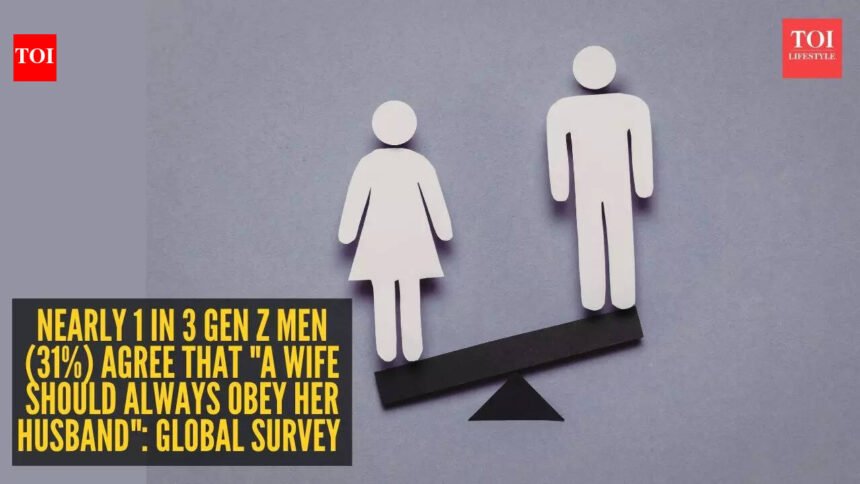
You’d think that in 2026, the generation that grew up with the internet in their pockets and “inclusivity” in their school curriculums would be the most progressive group on the planet. We expected Gen Z to be the ones finally make partnership in relationships a norm.But a bombshell survey released on March 5—just in time for International Women’s Day—has surprised people on the internet. It turns out, Gen Z men (born between 1997 and 2012) are doubling down on old-school gender roles even harder than their fathers or grandfathers.King’s College London and Ipsos surveyed people across 29 countries, and quite unexpected. While the world is sprinting toward equality, a huge chunk of young men is hitting the “rewind” button. Let’s unpack why the “woke” generation is suddenly looking a lot like a 1950s sitcom.1. The “Obedience” GapThe most jaw-dropping stat from the report? Nearly one in three Gen Z men (31%) agree that “a wife should always obey her husband.” To put that in perspective, only 13% of Baby Boomers agree with that.Let that sink in: Young men today are more likely to want an “obedient” partner than the men who actually lived through the Mad Men era. Meanwhile, only 18% of Gen Z women buy into that line. We aren’t just looking at a difference of opinion; we’re looking at a sociological chasm. Experts suggest this is a “backlash” effect—as women gain more independence, some young men are clinging to traditional hierarchies to reclaim a sense of control in an uncertain world.2. The “Boss Babe” ParadoxGen Z men are currently walking contradictions. The survey found that 41% of them find a woman’s career success and ambition incredibly attractive—the highest of any age group. They want a partner who brings home the bacon.However, here’s the plot twist: * 24% of those same men say women shouldn’t seem “too independent” or “self-sufficient.”21% believe a “real woman” never initiates sex (that’s triple the rate of Boomers).Ipsos UK boss Kelly Beaver calls this the “great re-negotiation.” It’s the ultimate cherry-picking move: Wherein most Gen Z men want the perks of a double-income household while still wanting their partners to obey them. It’s a “wanting a boss babe who still handles 100% of the emotional labour and chores” vibe, and it’s fueling a lot of the dating burnout we see today.3. The “Tough Guy” PrisonIt’s not just women who are being boxed in by these views; Gen Z men are caging themselves, too. About 30% of them believe men shouldn’t tell their friends “I love you,” compared to only 20% of Boomers.“Not only are many Gen Z men putting limiting expectations on women, they are also trapping themselves within restrictive gender norms,” said Julia Gillard, chair of the Global Institute for Women’s Leadership.Between “hustle culture” influencers and “red-pill” forums preaching that vulnerability is a weakness, young men are being taught that stoicism is the only path to respect. The result? A generation of guys who are statistically lonelier and more anxious than those before them. When you can’t tell your best friend you care about them, you’re not being “tough”—you’re being isolated.4. The Ghost of Social PressureHere is the weirdest part: the world is actually more progressive than we think it is.The Reality: Globally, only 21% of people actually think men should “rule the roost” at home.The Perception: However, 31% of people believe that society expects them to act that way.Professor Heejung Chung, director of the Global Institute for Women’s Leadership, calls this “false pressure.” We are misreading the room because of loud, polarized voices on social media. We assume everyone else wants a “traditional” setup, so we conform to a ghost that doesn’t actually exist. This gap is fixable, but it requires us to start having honest, raw conversations that go deeper than an Instagram comment thread.Why This Matters for the FutureThis isn’t just a “dating problem.” It’s a workplace problem, a mental health problem, and a societal problem. We are seeing a mismatch in the “mating market” where women are seeking equals and a growing segment of men are looking for a return to tradition.If we don’t bridge this gap with curiosity rather than just judgment, we’re looking at a future of massive resentment. The solution isn’t to shame young men for feeling lost; it’s to show them that equality is a promotion for everyone. It means they don’t have to carry the financial burden alone, they don’t have to suppress their emotions, and they get to have a partner, not an “obedient” subordinate.What are your views on this survey result? Tell us in the comments below.