
Beneath the surface of just a few meters of water lie two shipwrecks from ancient times near the coast of Caesarea, revealing an understanding of what happened in the past concerning the use of ships. This discovery near the Mediterranean Sea contains valuable gold, coins, and other items related to two different periods of history. The findings suggest that these two shipwrecks can be traced to the eras of the Romans and the Mamluks, with more than one thousand years separating the two periods. The environment played a part in the discovery since shifting sand uncovered and covered up the remains over time.
Mediterranean shipwreck coins in shallow waters reveal ancient trade routes
According to the Armstrong Institute, the two shipwrecks were found at a depth of approximately four metres in a coastal zone known for unstable maritime conditions. This section of the Mediterranean coast has long been exposed to seasonal storms and strong wave activity, making navigation and anchoring difficult. Archaeological assessments suggest that both vessels may have been anchored offshore when adverse weather conditions intensified. Anchoring in shallow, open waters without natural harbour protection increased the likelihood of structural damage. Over time, wave force and sediment movement contributed to the fragmentation of the ships. The shifting seabed played a key role in both preserving and redistributing the remains, allowing artefacts to remain partially buried until recent exposure.The finds included a considerable amount of money that dates back some 1,700 years and also some others dated at about 600 years ago. Many of these coins are of the Mamluk period, made of silver. The money was not kept in any containers but was found spread out over the bottom of the seabed. This suggests that the ships probably broke up during the wrecks, scattering the items all over the place. Finding money of many different periods suggests that the area had seen a lot of trading activity throughout time. This conforms to the history that shows this eastern region as a commercial artery in ancient times.
Personal artefacts highlight the presence of individuals on board
Apart from the cargo, there were also personal artefacts found, which serve as evidence of the people who were on board the ships. One of the artefacts discovered is a red stone bearing an engraved lyre, which was probably used for a gemma ring. This symbol is said to be connected with the culture and religion of the Kinor David. Other artefacts discovered include bronze bells, ceramic pots, and miniature figurines. It appears that these were personal artefacts owned by the travelers or the crewmen of the ship.
Ancient gold ring with Good Shepherd symbol highlights early Christian identity and symbolism
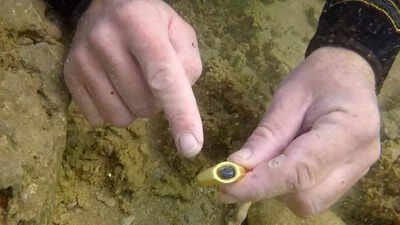
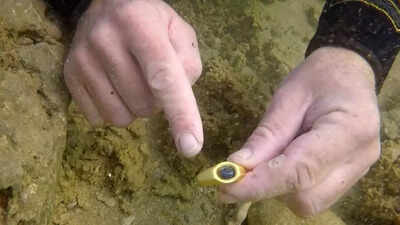
Perhaps one of the most interesting artefacts found was an octagonal gold ring with an emerald stone, engraved with a representation of the “good shepherd” with a sheep. This can be interpreted as a reference to early Christianity, and the artefact is a sign of the “Good Shepherd,” which denotes protection and guidance from a higher power. This finding gives us insight into early religious practices in the region and adds cultural value to such an object. Thus, the artefacts have significance beyond mere physical characteristics, but cultural value as well.The second artefact includes some objects that are indicative of the use and design of the ship itself. Objects such as an iron anchor, lead pipes (possibly part of a bilge pump system), a bronze eagle, and a theatrical mask were found. These objects give information on the practical design of the ships as well as the cultural setting of the people who used them. Thus, they represent not only the engineering aspect but also the culture aboard such ships.
Roman and Mamluk shipwreck artefacts reveal maritime history
The two shipwrecks represent separate events that occurred in the same coastal region but during different historical periods. The combination of Roman and Mamluk artefacts within a shared area highlights the long-term use of this maritime route. The recovered materials collectively document trade patterns, navigation risks, and the presence of individuals engaged in seafaring activities. The shallow depth of the site and the influence of environmental conditions contributed to both the preservation and eventual discovery of the artefacts. These findings provide a structured record of maritime history, supported by physical evidence recovered directly from the seabed.