
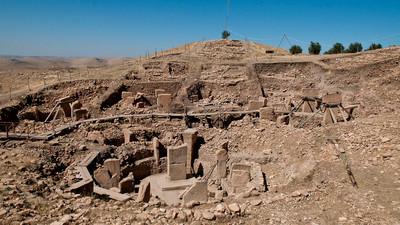

Long before there were even any cities, any farming, or any pottery, people gathered on a hill in what is now southern Turkey and created something incredible. Huge stone pillars, decorated with animals and symbols, were arranged in massive circular formations. This is believed to be the oldest temple the world has ever known. Dating back to nearly 12,000 years ago, it has caused archaeologists to rethink the very beginnings of civilisation. Just as quickly as it had arrived, it had been deliberately buried, and the people who had built it had seemingly vanished. However, new discoveries are continually uncovering new aspects of the mystery.
Göbekli Tepe : Turkey’s 9600 BCE temple built by hunter-gatherers
Discovered in the 1990s and extensively studied by German archaeologist Klaus Schmidt told the BBC, It’s ancient, about 9600 BCE, long before Stonehenge or the pyramids. It’s got large circular buildings with massive T-shaped limestone pillars that rise high into the air, some weighing tons and decorated with pictures of animals, foxes, lions, birds, looking down at you. What’s even stranger is that these were built by hunter-gatherers who hadn’t yet domesticated plants or developed cities. In fact, they apparently survived by foraging in the wild, but somehow managed to build this. Schmidt’s take? “It’s a supernova, a moment in time that utterly revolutionises our view of the early history of humans.”
A discovery that rewrites human history
For a long time, it’s been understood that farming came first and that after that came settling and then building monuments and temples. Göbekli Tepe flips this whole process upside down.The evidence suggests that this place came about before there were farmers and that it’s possibly a case of shared beliefs and rituals bringing people together. Some believe that this process of building such large structures may have been what started farming in the first place.As suggested by Schmidt, Göbekli Tepe may be a turning point in history in which religion and working together sparked the beginning of civilisation. It’s been bandied about in academic circles that it may have been “possibly the spark that launched mankind toward farming.”Adding to the intrigue is that there’s no sign of homes or living spaces at this location. In one interview, Schmidt asks the question that’s still on everyone’s mind: “We have found no homes… Where is everyone?”This suggests that people may have travelled from distant regions to gather here for rituals or ceremonies, before dispersing again.
Why was Göbekli Tepe deliberately buried
One of the most puzzling aspects of Göbekli Tepe is not how it was created, but why it was intentionally buried. Around 8000 BCE, the entire site was intentionally buried under tons of dirt and debris.This was not done because of any natural disaster. As a summary of research done on Göbekli Tepe states, the layer that hid the site was “put here by man himself.”
Why would a civilisation bury something so monumental
There is no single answer, but several theories exist:
- The site may have lost its religious significance
- A cultural or societal shift may have made it obsolete
- New belief systems could have replaced old ones
- It may have been intentionally preserved or hidden
Schmidt himself admitted the uncertainty, stating that the reason remains unknown, though the act clearly marked “the end of a very strange culture.”
The disappearance of the builders
The big question that lingers in the minds of people is what happened to the people who built Göbekli Tepe. There are no telltale signs of a sudden disaster or wars and an exodus. What we do find is a gradual decline, and this is linked to the larger changes in the way people lived. At the same time that Göbekli Tepe was being built, there were signs of the earliest farming and the emergence of settled communities. This suggests that the people who built Göbekli Tepe did not disappear but evolved. They moved away from the ritual gatherings and towards the settled communities and farming. Göbekli Tepe is thus the final chapter of the hunter-gatherer way of life and the first page of a new chapter for humanity.
Why Göbekli Tepe still matters today
Göbekli Tepe isn’t just an ancient site; it’s a gateway to a time in human history when the world was poised on the brink of a revolution.It challenges all the old theories about the origins of civilisation, suggesting that faith, cooperation, and shared goals may have been as important as the need to survive.Today, the majority of the site remains buried underground, with only a small portion excavated so far. This means that there is still much to be discovered in the future.At the end of the day, Göbekli Tepe teaches us that the story of the development of civilisation is far more complex and intriguing than we had previously believed.