
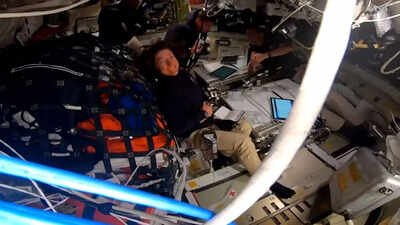

NASA‘s Artemis 2 mission has accomplished another difficult milestone by restoring essential communication with Mission Control after going dark for about 40 minutes previously. As the Orion spacecraft passed behind the far side of the Moon, there was a complete loss of radio communications due to the Moon blocking it. This ‘loss of signal’ (LOS) time was a true test of both the crew’s ability to function independently and of the automated systems of the spacecraft. The crew re-established contact with Mission Control at 7:24 PM (EDT) Eastern Daylight Time on April 6, 2026, and reported that all systems were performing as expected. This has been the longest distance humans have been into deep space, and it also lays the groundwork for the mission to return.
NASA’s Orion goes silent behind the Moon before witnessing a rare total solar eclipse
According to NASA, on April 6th, 2026, at 6:44 PM EDT, Orion traversed behind the moon (blocking the signals from NASA’s Deep Space Network), causing a Communication Blackout. Orion then performed its first close flyby of the Moon, at 7:02 PM EDT, flying just 4,067 miles above its surface. After restoring communication with the spacecraft, the Artemis II mission entered its unique solar eclipse phase at 8:35 PM EDT, where the crew experienced a total solar eclipse (where the Moon completely occluded Sun) for 53 minutes from the Orion’s perspective, providing them with an opportunity to study the solar corona (Sun’s outer atmosphere) without any interference from direct sunlight.
Orion surpasses historic deep space record
At 7:07 PM EDT, the Artemis II crew officially broke the previous human distance travelled record from Earth. Orion reached its maximum distance from Earth of 252,756 miles and was 4,111 miles farther than the crew of Apollo 13 set in April 1970, which was 248,655 miles. Artemis II achieved this milestone while its crew were conducting high-altitude lunar observation (collecting data on the Moon’s minerals & geology) utilising high-resolution imagery.
NASA prepares for April 10 splashdown
When Orion rose above the Moon at 7:25 PM EDT, the astronauts witnessed a beautiful ‘Earthrise’ as Mission Control obtained the signal from Orion. Over seven hours, the crew was able to use this observation period to visually confirm and record different parts of the Moon, such as the Orientale Basin and the Hertzsprung Basin. The spacecraft is now on a free-return trajectory, which uses the gravity of the Earth and the Moon to send the crew back to the Pacific Ocean for a splashdown on April 10.
How NASA and the US Navy will retrieve orion
NASA and the US Navy have started the mission recovery phase to bring the crew home safely. The USS John P. Murtha, a San Antonio-class amphibious transport dock ship, has left Naval Base, San Diego, to arrive at the designated recovery zone. The ship has special equipment, including a recovery cradle, high-speed boats, and other tools, that are specifically designed for retrieving the Orion capsule from the open ocean. NASA’s Exploration Ground Systems team is on board to coordinate the ‘Open Ocean Recovery’ operations.As of now, mission control is awaiting the exact time of splashdown. The planned time of splashdown is 8:07 PM EDT (5:07 PM PDT) on April 10. The planned location for splashdown is also in the Pacific Ocean, approximately 60 miles offshore from San Diego, California. At the time of splashdown, Navy divers will secure the capsule using a ‘horsecollar’ to stabilise it before winching the capsule into the flooded well deck of the USS John P. Murtha. This procedure allows for coordinated recovery operations, which will allow for the safe recovery of the astronauts and the return of the spacecraft for post-flight analysis.