
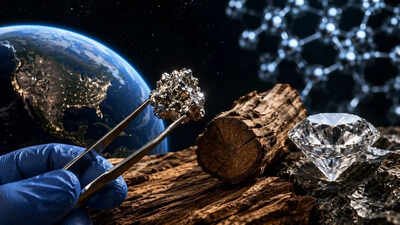

A spacecraft drifting past Neptune would not need much imagination to picture diamonds forming in its atmosphere. Deep inside ice giants, carbon compounds are squeezed under pressures that break molecular bonds and reorganise atoms into crystalline structures. In lab experiments and planetary simulations, scientists have modelled this “diamond rain” for decades, and missions like NASA’s Voyager flybys helped refine those interior models. Meanwhile, telescopes studying interstellar clouds have picked up evidence of nanodiamonds, tiny carbon crystals suspended in dust between stars. The universe, it turns out, is quite comfortable making diamonds.Wood is a different story entirely. You don’t find it in planetary atmospheres or drifting through nebulae. You find it in living systems that can sustain metabolism, transport water, and build structured polymers over time. That distinction is where the real divide begins.
The role of pressure, heat, and time in creating cosmic diamonds
Carbon is one of the most flexible elements in chemistry. Under the right conditions, it rearranges into graphite, fullerenes, or diamond. In high-pressure environments like the interiors of Uranus and Neptune, methane is thought to break apart, freeing carbon atoms that can crystallise into diamond structures as they sink deeper under gravity.This is not a biological process. No enzymes, no cells, no energy capture. It is thermodynamics doing the work.Even supernova remnants contribute. When stars exhaust their fuel and collapse or explode, carbon-rich material can cool and condense into crystalline forms, including microscopic diamonds. Some of these grains survive long enough to become part of interstellar dust clouds, later incorporated into new star systems and even meteorites that land on Earth.The key point is simple. Diamonds are a natural outcome of pressure, temperature, and time. Life is not required.
Wood is chemistry organised by biology, not pressure
Wood does not form under compression or heat. It forms through metabolism.At its core is cellulose, a polymer built from glucose produced during photosynthesis. Trees take in carbon dioxide, water, and sunlight, then assemble long chains of cellulose that provide structure. Lignin, another complex polymer, fills the gaps and adds rigidity, making wood both strong and flexible.This process depends on multiple systems working together: vascular transport to move water from roots, enzymatic pathways to build polymers, and seasonal cycles that influence growth rings. Each ring in a tree trunk is effectively a record of environmental conditions, rainfall, temperature shifts, even stress events like droughts.Without this biological machinery, wood simply does not exist. Carbon alone is not enough.
A common misconception about “rarity” in the universe
According to Hashem Al-Ghaili, Yemeni molecular biologist and science communicator, in a Facebook post, diamonds are “common” and wood is “rare,” but that comparison only works if both materials are assumed to be natural physical outcomes of the cosmos. They are not. This is where popular science writing often oversimplifies things. The presence of complex carbon structures in space does not imply an abundance of biological materials. Even amino acids and organic molecules detected in meteorites, such as the Murchison meteorite that fell in Australia in 1969, do not indicate life. They indicate chemistry that can happen without it.Wood requires more than chemistry. It requires sustained energy flow, compartmentalization, reproduction, and evolutionary history. So far, Earth is the only confirmed system where all of that has converged into forests.
What this contrast actually tells us about life in the universe
The real takeaway is not that wood is “rarer than diamonds.” It is that we are comparing two fundamentally different categories of matter.One emerges wherever physics allows atoms to settle into stable arrangements under pressure. The other emerges only where chemistry is organised into self-sustaining systems capable of growth and adaptation.That distinction matters when we think about life beyond Earth. Finding diamonds elsewhere tells us almost nothing about biology. Finding something like wood, structured, layered, growth-based carbon architecture shaped by metabolism, would mean something far more significant. For now, every tree ring on Earth is doing something the rest of the universe does not appear to do: record time through life.