
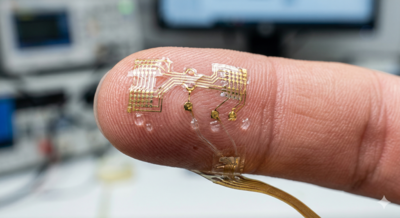

Imagine a world where your fitness tracker or smart watch never needs to be recharged, not because it has a battery that never dies, but simply because your body provides the power it needs to function. In a breakthrough scientific achievement, a group of Japanese scientists have created a wearable device that uses the electricity in human sweat to function. Such a device could revolutionise the future of wearable technology, making it more sustainable, efficient, and integrated into our daily lives than it has ever been before. Using a function that the body naturally produces, scientists are getting closer and closer to a future where charging cables and batteries are a thing of the past.
Sweat-powered sensors: A breakthrough in wearable technology
At the core of this innovation is a biofuel cell, a technology that harnesses biochemical energy to generate electricity. For instance, Japanese scientists, especially those from the Tokyo University of Science, have developed sensors that harness compounds in sweat, such as lactate, to generate electricity. Lactate, a by-product of physical activity, is used as a source of fuel. As soon as it comes into contact with special enzymes on the sensors, a reaction is triggered, thus creating electricity. As one research study noted, these sensors “generate electric power from the lactate in the wearer’s sweat,” thus creating a constant flow of electricity. This, in essence, implies that even a simple action, such as walking, exercising, or even sweating, can generate electricity.
How sweat generates electricity
There are a number of ways that scientists are improving the performance of sensors that can run off sweat. One of the most important methods for developing sweat-powered sensor technology is improving how they are made. Scientists have developed a process to create sweat-powered sensors that can be produced through a single-step process using enzymes in ink printed on nearly any type of substrate, including paper and clothing fabric. Because of these substantial advancements in the development of sweat-powered sensors, it is possible to manufacture them at a large scale, and thus they are being used to power devices like activity monitors and Bluetooth devices.
Applications: From health monitoring to smart wearables
The implications of these sweat-powered sensors are far-reaching beyond just convenience. The potential of these sensors can be realized in the field of health monitoring.Sweat possesses significant biomarkers like electrolytes, glucose, and lactate, which are all indicative of the physiological condition of the human body. According to a study by scientists, these wearable sensors can give us access to “continuous, real-time physiological information.” Another study done by the University of Chinese Academy of Sciences (UCAS) revealed that with the creation of a sensing-power device, researchers are developing self-powered health monitors. This can potentially be used to monitor fitness levels, hydration, stress, or even detect early stages of illness, all without the need to recharge the device.This technology can potentially be used in the following ways in the future:
Fitness trackers or smartwatches- Medical patches for patients
- Military or extreme environment equipment
- Smart textiles or clothing
The future of battery-free electronics
Although still in the developmental stage, sweat-powered sensors mark an important advancement in battery-free electronics. One of the greatest difficulties associated with wearable technology has been that of power supplies. Traditional batteries are cumbersome, need recharging, and also contribute to environmental degradation. In research done by the Department of Health and Physical Education, Jianghan University, it is stated that such systems will be “self-powered” and that they “represent a sustainable solution.” It goes on to highlight that such technologies will allow us to “interact with electronic devices in ways that are fundamentally different because they can function continuously without external power or charging.” There is still a long way to go in terms of improving such technologies to make them more powerful and longer-lasting. However, with rapid advancements in both materials science and bioengineering, the prospects look bright. In the coming years, your body could be your own power source, silently driving the devices that keep you connected, informed, and healthy.