
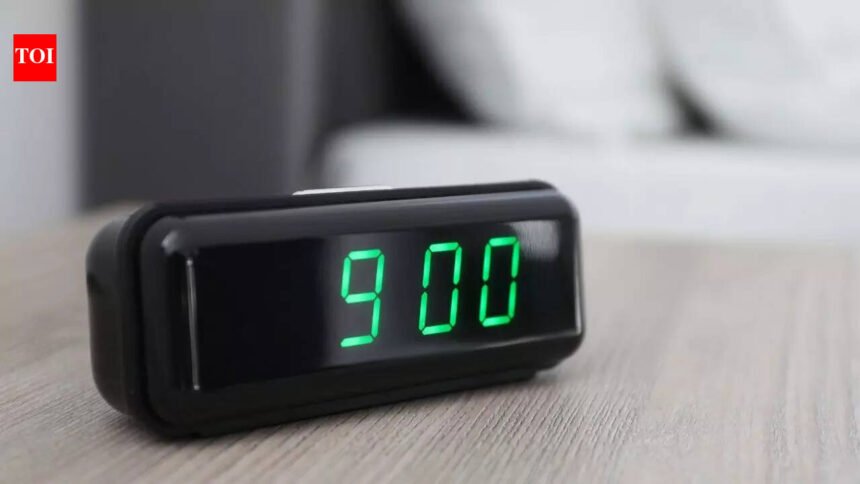

The snooze button is one of the most common things on an alarm clock. For many people, it offers a short break between sleeping and waking up. While using it has become routine, one detail often goes unnoticed. The snooze interval is rarely five or ten minutes. Instead, it is almost always set to nine minutes. This oddly specific number has existed for decades and continues to appear on modern digital clocks and smartphones. The reason behind this is not related to sleep science or human behaviour. According to historians and engineers who have studied early clock design, the answer lies in the mechanical limitations of old alarm clocks. What began as a practical engineering choice has become a global standard that still affects how people wake up every day.
The history of the snooze button in mechanical alarm clocks
In the middle of the 20th century, mechanical alarm clocks got the snooze button. These clocks operated using gears, springs, and levers rather than electronic circuits. According to historical records referenced by the Smithsonian Institution, mechanical clocks were limited by how their internal gear systems could be divided.At the time, clockmakers wanted to add a feature that delayed the alarm without redesigning the entire mechanism. Creating a precise and adjustable delay was difficult with mechanical parts. Engineers had to work within existing gear ratios, which restricted how much time the alarm could be postponed.
Why the snooze button is set to 9 minutes
The nine-minute snooze was not chosen deliberately for comfort. It was the most practical option engineers could achieve. According to explanations cited by BBC Future, early alarm clocks divided time using gear systems that made a 10-minute delay mechanically inefficient.A 9-minute delay fit more easily into the gear layout of these clocks. Extending it to a full 10 minutes would have required extra components, making clocks more expensive and less reliable. As a result, manufacturers settled on nine minutes as a workable solution.
Engineering constraints behind early alarm clock design
Mechanical alarm clocks worked by moving gears in a set way. Every time you hit the snooze button, a gear moves forward by a set amount. That movement caused a delay in the alarm going off again.According to design historians referenced by the Smithsonian Institution, nine minutes was the closest engineers could get to a “short break” without altering the clock’s core structure. The choice was based entirely on mechanical efficiency, not on user psychology or sleep research.
Why digital alarm clocks kept the 9-minute snooze time
When digital alarm clocks became common, the mechanical limitations disappeared. Manufacturers could now program any snooze duration they wanted. Despite this, most companies retained the nine-minute standard.According to technology explainers published by BBC Future, the decision was driven by user familiarity. People had grown used to the timing over several decades. Changing it could have disrupted established habits. As a result, the nine-minute snooze carried over into digital clocks, mobile phones, and smart devices.
Is the 9-minute snooze scientifically proven to be better
There is no scientific evidence that nine minutes is ideal for waking up. According to the National Sleep Foundation, repeatedly pressing the snooze button can fragment sleep and increase morning grogginess.Sleep experts generally recommend setting an alarm for the final waking time instead of relying on multiple snoozes. This proves that the nine-minute break is there because of design choices made in the past, not because it is good for your health.
Why the 9-minute snooze still exists today
The nine-minute snooze button is still used, which shows how older technologies affect modern design. Researchers at Bell Labs who study industrial design say that a lot of everyday features stay the same because users expect them to work a certain way.Manufacturers usually like things to stay the same rather than change, especially when it comes to simple, familiar tasks like setting alarms. This is why the length of time that the snooze button works has stayed mostly the same over time.