
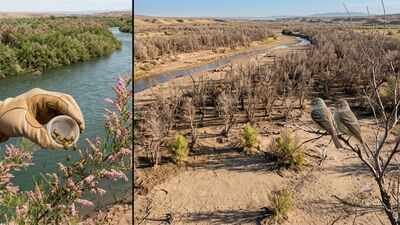

The breeding grounds of the Southwestern Willow Flycatcher stretch across thousands of kilometres of rivers and streams in the American Southwest, yet much of its habitat has long been difficult to assess in a consistent way. Thick vegetation, changing river systems and seasonal drought all make monitoring the small migratory bird a complex task. A report from the U.S. Geological Survey offers a broader picture than conservation agencies have had before, bringing together satellite observations to map suitable breeding habitat across the bird’s entire range. The work provides land managers with a way to monitor habitat changes over time while also helping them identify areas where emerging threats could have the greatest effect on one of the United States’ federally protected endangered bird species.
Southwestern Willow Flycatcher breeding habitat and conservation
The Southwestern Willow Flycatcher is a small songbird that depends on dense riverside vegetation for nesting during its breeding season, which generally runs from May until September. It occupies riparian corridors across parts of the southwestern United States, relying on healthy stands of shrubs and trees growing beside rivers and streams.Its conservation has been a long-standing priority under the Endangered Species Act. In 2013, the U.S. Fish and Wildlife Service identified nearly 1,975 stream kilometres of critical habitat spanning six states and 38 counties. Protecting such an extensive and fragmented landscape has remained difficult because conditions can shift from one year to the next through drought, flooding, vegetation change and human activity.The USGS report attempts to bridge that gap by using satellite-based modelling to examine breeding habitat across the species’ full distribution instead of relying only on local field surveys.
How satellite mapping tracks changes in flycatcher habitat
Rather than focusing on individual nesting sites, the satellite model evaluates vegetation patterns over entire watersheds. That allows scientists to identify places likely to support breeding flycatchers and observe how those areas expand or contract over successive years.According to the report, yearly climate differences leave a clear mark on available habitat. During the severe drought years between 2013 and 2015, suitable habitat declined across parts of California. At the same time, conditions improved in portions of New Mexico and Texas, illustrating how regional weather patterns can reshape breeding opportunities across the bird’s range.The approach also provides conservation agencies with a consistent way of comparing landscapes spread across several states, something that has previously been difficult using field observations alone.
An introduced beetle creates an unexpected conservation challenge in 2001
The report examines another issue affecting the species: the spread of the tamarisk leaf beetle.The insect was intentionally introduced in 2001 by the U.S. Department of Agriculture’s Animal and Plant Health Inspection Service as a biological control for invasive tamarisk trees. Tamarisk, sometimes called saltcedar, had spread widely along rivers and streams throughout the western United States, displacing many native plants and altering river ecosystems.Since those original releases at ten locations across six western states, the beetle has expanded well beyond its initial range. Populations are now established in parts of the Colorado River Basin, sections of the lower Colorado River in Arizona and stretches of the Rio Grande in New Mexico.While reducing invasive tamarisk has environmental benefits in many places, the relationship with the flycatcher has proved more complicated.
Why tamarisk matters to the flycatcher
Although tamarisk is not native, many Southwestern Willow Flycatchers have adapted to nesting within mature stands where native riverside vegetation has disappeared. When beetles strip the trees of their leaves during the breeding season, nests become exposed to higher temperatures and predators.The satellite model highlights how severe those effects can become in certain river systems. Along the lower Virgin River, the report estimates that suitable flycatcher habitat declined by about 94% between 2010 and 2015, leaving only a small fraction of the original habitat.Looking ahead, the modelling suggests further reductions could occur if the beetle continues spreading. Habitat along the lower Colorado River could decline by roughly 36% over the coming decade, while the upper Gila River may lose around 55% of its suitable breeding habitat under projected conditions.
Helping conservation managers decide where to act
The mapping system is intended to support practical management rather than simply document habitat loss.By identifying areas most vulnerable to future beetle activity, agencies can decide where restoration work may have the greatest benefit. Current efforts include removing invasive tamarisk where possible, restoring native riverside vegetation and planting native habitat on land that was previously used for agriculture.How effective those projects will be over the long term is still uncertain. Even so, having a landscape-scale picture of habitat allows managers to prioritise locations before conditions deteriorate, rather than responding after breeding areas have already been lost.The model also offers a way to monitor whether restoration work creates new habitat capable of supporting future flycatcher populations.
A collaborative effort across federal agencies
The report was produced through collaboration between the U.S. Geological Survey, the U.S. Fish and Wildlife Service and the U.S. Bureau of Reclamation.Beyond mapping existing habitat, the project combines information on vegetation and beetle expansion to estimate how breeding areas may change over time. That gives wildlife agencies another source of evidence when planning conservation actions, evaluating restoration projects and meeting obligations to protect habitat linked to federally listed endangered species.