
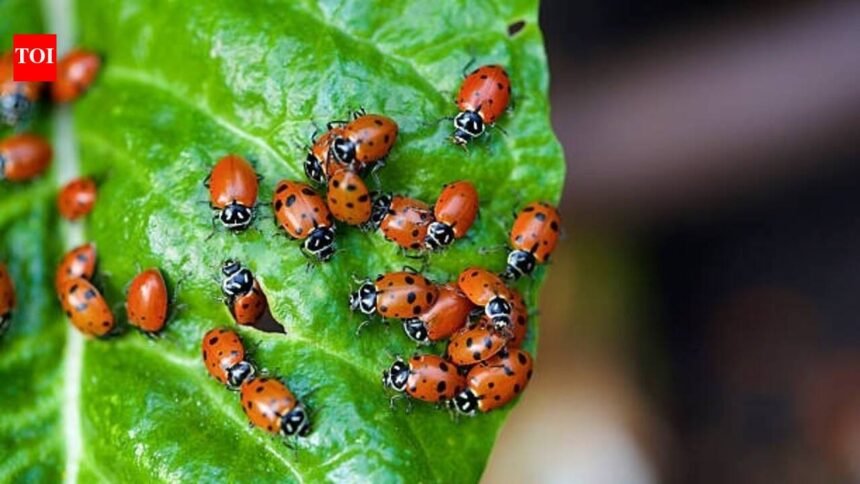

Few insects manage to be both genuinely useful and adored the way ladybugs are, which is a fairly rare combination in the garden world. Most beneficial insects tend to be the kind you tolerate rather than actively enjoy seeing, but ladybugs have somehow earned a reputation as the one bug almost everyone, gardener or not, is happy to spot on a leaf. That affection isn’t just sentimental, either. Ladybugs happen to be one of the most effective natural pest-control agents available to home gardeners, quietly doing work that would otherwise mean reaching for a chemical spray. Here are five genuine reasons they’ve earned their spot as a gardener’s favourite.
They’re relentless aphid hunters
Aphid control is the reason ladybugs became garden legends in the first place, and the numbers back up the reputation. Extension research puts the daily appetite of an adult ladybug at somewhere between 50 and 100 aphids, with University of Georgia Cooperative Extension estimating a single beetle can consume 500 to 1,000 aphids over the course of its lifetime, while University of Kentucky Extension has cited figures as high as 5,000. Whatever the precise number, the pattern is consistent: a healthy ladybug population can meaningfully suppress an aphid outbreak before it has the chance to spread across an entire plant.
Their larvae are even hungrier than the adults
This is the detail most people miss entirely, mainly because ladybug larvae look nothing like the familiar red-and-black beetle and are easy to mistake for a pest themselves. Larvae can’t fly, which means they stay put in the middle of an aphid colony rather than dispersing, and research from the University of California’s agriculture programme notes that larvae can eat up to 500 aphids each during their development, arguably making them the more effective pest controller of the two life stages. Learning to recognise the larvae, rather than accidentally squashing them, matters just as much as attracting the adults.
They don’t stop at aphids
While aphids are clearly the headline prey, ladybugs are far from one-trick predators. Beyond aphids, they’re known to feed on mites, mealybugs, scale insects, and whiteflies, all common culprits behind stunted growth, sticky leaf residue, and general plant stress in home gardens. That range makes them a genuinely versatile ally rather than a narrow solution to one specific pest, which is part of why they’re considered such a foundational piece of natural pest management rather than a one-off remedy.
They cut down the need for chemical sprays
For gardeners trying to avoid pesticides, especially in a vegetable patch or herb garden where anything sprayed eventually ends up on the plate, ladybugs offer a genuinely practical alternative. Because they target specific soft-bodied pests rather than indiscriminately affecting every insect in the vicinity, they help protect other beneficial visitors, particularly bees and other pollinators, that broad-spectrum sprays would otherwise wipe out along with the pests. Leaning on ladybugs instead of chemicals is less about eliminating every pest overnight and more about keeping populations in a manageable, sustainable balance over time.
They’re a sign of a genuinely balanced garden
Here’s an honest caveat worth knowing: simply buying a container of ladybugs and releasing them isn’t the guaranteed fix it’s often marketed as. University research has found that a large share of released ladybugs disperse and fly off within just four or five days rather than settling in to feed, which means the more reliable approach is actually attracting them naturally rather than relying on a one-time release. Planting dill, yarrow, cosmos, or marigold, and leaving out a shallow dish of water, tends to draw them in and, more importantly, keep them around, which is exactly why a garden that regularly hosts ladybugs on its own is usually a sign that the wider ecosystem, plants, pests, and pollinators alike, is already in decent balance.
A small beetle doing big work
What makes ladybugs such a consistent favourite isn’t just how much damage they prevent, it’s how little they ask for in return. A garden that offers a bit of pollen, some flowering plants, and a chemical-free environment tends to keep them coming back on its own, turning what could be an expensive, repeated pest-control routine into something that largely takes care of itself.