
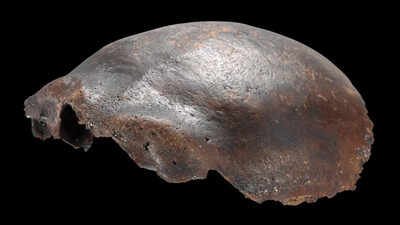

In 1973, a partial human skull was uncovered in Hahnöfersand, Germany, during archaeological work. It did not come with any clear cultural objects nearby, which made early classification difficult. At first glance, the bone seemed unusual. Its shape carried features that looked partly Neanderthal and partly modern human. That observation led some researchers to suggest a possible hybrid origin between Neanderthals and Homo sapiens. The idea gained attention because both species are known to have overlapped in parts of Europe and the Middle East. Over time, the interpretation changed as new dating methods and analyses were applied. What once looked like a rare hybrid case now appears to be something much more ordinary within modern human variation.
Hahnöfersand skull frontal bone discovery and early Neanderthal hybrid theory
According to Scientific Reports, titled, A morphological analysis of the modern human frontal bone from Hahnöfersand, Germany, the fragment was a frontal bone, found in northern Germany. It was not a complete skull, just a portion of the upper forehead region. The lack of surrounding artefacts made the context unclear. No tools. No burial objects. Just the bone itself.Researchers at the time had limited material to work with. They focused on shape and structure. The specimen showed traits that seemed unusual compared to typical modern human skulls from similar periods. Initial studies described the bone as showing a mix of Neanderthal and Homo sapiens features. The timing seemed to fit early assumptions about interbreeding between the two groups. Radiocarbon dating at one stage placed the specimen at around 36,000 years old. That period overlaps with known contact between Neanderthals and modern humans.Because of this, the idea of a hybrid gained traction. It was not a wild claim at the time. Interbreeding is well established in genetic evidence today. Small percentages of Neanderthal DNA still exist in most non-African human populations.
New dating evidence rewrites the timeline entirely
Subsequent analyses changed the picture quite a bit. More refined dating methods suggested the bone is much younger than first thought. Estimates placed it closer to 7,500 years old. By that time, Neanderthals had already been extinct for tens of thousands of years. No direct overlap existed anymore. A hybrid origin became unlikely based on timing alone.The specimen instead fits into the Mesolithic period, a phase of human history marked by modern Homo sapiens populations living across Europe with evolving tool use and social structures.
3D analysis confirms the bone falls within modern human variation
A more recent study applied three-dimensional comparative techniques. The bone was measured and compared against a large dataset of Neanderthal and modern human skulls from different periods.The results placed the Hahnöfersand frontal bone firmly within modern Homo sapiens variation. Not intermediate. Not mixed. Just within the range of normal human skull diversity.Researchers noted that earlier impressions of “Neanderthal-like” traits may have come from its shape appearing slightly unusual compared to some reference samples. But that variation also exists within modern populations, including medieval and Holocene skulls.
Genetic evidence confirms ancient hybridisation between species
Neanderthals and modern humans did interbreed in the past. Genetic evidence supports this clearly. It likely occurred in multiple regions, especially in the Middle East around 100,000 years ago, and later in parts of Europe. Some populations carried mixed traits for thousands of years. Fossil remains from certain cave sites suggest a possible blending of cultural and biological features.Still, those cases belong to a much earlier timeline than the Hahnöfersand find. By the time this frontal bone formed, Neanderthals were no longer present. The population landscape had shifted entirely to Homo sapiens groups adapting across Europe during the Mesolithic period.