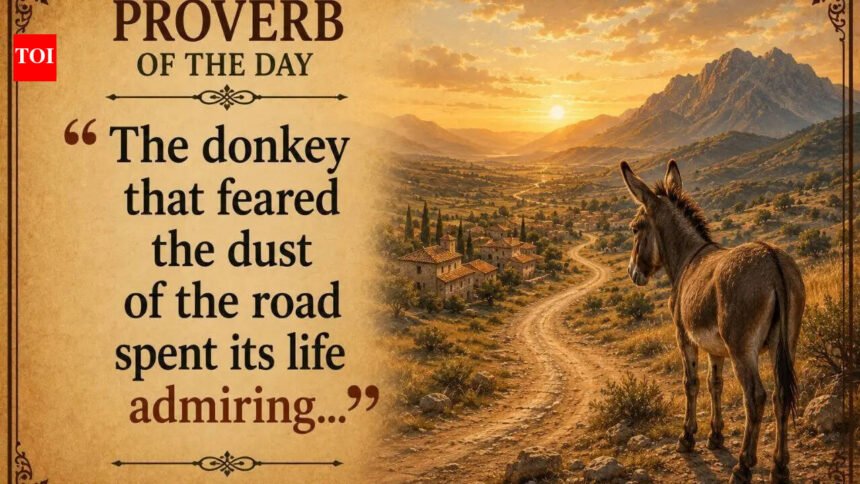

Every so often, a proverb comes along that feels less like advice and more like a mirror. This saying is one of them.“The donkey that feared the dust of the road spent its life admiring distant gardens.”The image is simple enough to understand. A donkey stands at the edge of a road. Somewhere beyond that road lie beautiful gardens. Perhaps they are greener, richer, and more rewarding than anything nearby. Yet reaching them requires a journey. There will be dust. There will be discomfort. There will be effort.The donkey chooses not to go.Instead, it stays where it is, looking at what might have been.It is a surprisingly powerful picture because most people can recognise a piece of themselves in it. Not necessarily the donkey, of course, but the hesitation. The moment when the fear of inconvenience becomes greater than the desire for something better.And that is where the proverb begins.
Proverb of the day
“The donkey that feared the dust of the road spent its life admiring distant gardens.”
The road was never supposed to be clean
One of the most interesting things about this saying is that the obstacle isn’t a mountain, a storm, or some impossible challenge.It’s dust.Dust is annoying. Dust gets into your eyes, sticks to your clothes, and makes a journey less comfortable. What it doesn’t do is stop you from moving.That detail feels important.Many people imagine that missed opportunities happen because of huge barriers. Sometimes they do. Life can be genuinely difficult. Yet just as often, people are held back by smaller things. Discomfort. Uncertainty. The fear of looking foolish. The possibility of failure.The road remains open. The destination remains visible. The journey simply feels inconvenient. So nothing happens.
The gardens are always easier to admire from a distance
There is something strangely comforting about dreaming.Dreaming costs nothing.You can imagine opening a business, writing a book, changing careers, learning a language, moving to a new city, or pursuing a long-delayed goal without risking anything at all. Inside your imagination, there are no deadlines, no setbacks, and no awkward mistakes.Reality works differently.The moment a dream becomes a project, things get messy. There are forms to fill out. Skills to learn. Rejections to handle. Unexpected problems to solve.That is usually the point where some people stop.Not because the goal stopped mattering.Because the road became dusty.The gardens remain attractive from a distance precisely because they have not yet collided with reality.
Fear often disguises itself as practicality
Very few people say, “I’m afraid to try.”The mind tends to be more creative than that. Instead, fear often arrives dressed as logic.Maybe next year. Maybe when conditions improve. Maybe when there is more money. Maybe when there is more experience. Maybe when everything feels certain.The problem is that certainty rarely arrives. Most significant decisions are made without complete information. The people who achieve things are not always the bravest. Often, they are simply the ones willing to move forward before they feel fully ready.The donkey in the proverb probably had reasonable explanations for staying put.Most people do.
Looking back can be harder than moving forward
One of the quiet truths hidden in the saying is that regret has a long memory.Physical effort fades. Failed attempts become stories. Embarrassing moments are usually forgotten by everyone except the person who experienced them.Regret behaves differently. It has a habit of revisiting people years later.A missed opportunity can linger far longer than a difficult journey. Many older people, when reflecting on their lives, do not spend much time talking about the risks they took. They talk about the chances they let pass.The business they never started. The trip they never took. The conversation they never had. The dream they postponed until there was no time left. The proverb seems to understand this.The donkey doesn’t suffer because of the dusty road. The donkey suffers because it never walked it.
Most achievements begin with uncomfortable steps
There is a tendency to look at successful people and focus on the result.The published book. The thriving company. The completed degree. The finished marathon.What often gets overlooked is how ordinary the beginning looked.A first draft nobody wanted to read. A small business with its first customer. A beginner making mistakes. A runner struggling through the first mile.The glamorous part usually comes later. The dusty road comes first.That pattern appears again and again throughout life. The people who eventually reach the gardens are rarely the people who avoided discomfort. More often, they are the ones who accepted it as part of the journey.
Why the donkey is such a perfect character
The choice of a donkey is interesting.In folklore and storytelling, donkeys are often portrayed as stubborn, cautious, and resistant to change. Whether fair or not, that reputation makes the animal a useful symbol.The donkey isn’t incapable of reaching the garden.It isn’t too weak. It isn’t blocked by fate. It simply refuses to move because the journey appears unpleasant.That distinction matters.The proverb is not about inability. It is about reluctance. And there is a significant difference between the two.
A lesson that feels increasingly relevant
Modern life offers endless opportunities to admire gardens from afar.Social media allows people to watch others travel, build businesses, learn skills, write books, and pursue ambitions. Every day brings fresh reminders of what is possible.The danger is that observation can start to feel like participation.Watching someone else achieve something is not the same as taking the first step yourself.Reading about success is not the same as pursuing it.Admiring a garden is not the same as walking toward it.The proverb feels surprisingly relevant in this environment because it reminds people that distance changes nothing. The gardens remain distant until someone decides to accept the dust.
The wisdom hidden inside a simple image
What makes this saying memorable is its simplicity. It doesn’t lecture. It doesn’t offer a detailed philosophy. It presents a single image and allows the reader to conclude.A dusty road. A distant garden. A donkey unwilling to travel.Almost everyone understands the lesson immediately.Some may see it as a warning against procrastination. Others may interpret it as encouragement to take risks. Still others may view it as a reminder that worthwhile goals usually involve inconvenience.The beauty of the proverb is that it accommodates all those readings.
Final takeaway from the proverb
“The donkey that feared the dust of the road spent its life admiring distant gardens” is a gentle but pointed reminder that opportunities often come wrapped in discomfort. The journey toward something worthwhile is rarely clean, convenient, or completely predictable.Many people spend years waiting for ideal conditions before pursuing what they want. Yet the perfect moment rarely appears. The road remains dusty, the journey remains uncertain, and the choice remains the same.Move forward or stay where you are.The proverb suggests that those who reach the gardens are not necessarily the strongest, smartest, or luckiest. They are often the ones willing to accept a little dust along the way.