
Font ResizerAa
The Popular StoryThe Popular Story
  • Lifestyle
  • Sports
  • Entertainment
  • News
  • World
Search
  • Lifestyle
  • Sports
  • Entertainment
  • News
  • World
Follow US
Copyright © 2024 MP Media. All Rights Reserved.
The Popular Story > Blog > World > Stranger Things becomes real! Scientists create ‘living walls’ that grow and heal themselves |
World

Stranger Things becomes real! Scientists create ‘living walls’ that grow and heal themselves |

By Mohit Patel Last updated: March 23, 2026 4 Min Read
Share
Stranger Things becomes real! Scientists create ‘living walls’ that grow and heal themselves |


Contents
Inside the Canada Pavilion: Walls that live, breathe, and require daily careCarbon capture and the surprising role of shape in living walls
Stranger Things becomes real! Scientists create ‘living walls’ that grow and heal themselves

Concrete has been the backbone of construction for centuries. Roads, bridges, skyscrapers, and all of it rely on the same old inert material. It is hard, durable, and predictable. But a new material is quietly challenging that norm. It grows, breathes, and even heals its own cracks. Scientists have created a living wall material that behaves more like a tiny ecosystem than a traditional building block. It looks almost like science fiction, yet it has already been used in large-scale installations. Unlike regular concrete, this material changes over time. It captures carbon, builds itself up, and responds to its environment. And while it might not replace concrete tomorrow, it hints at a very different future for architecture.

Inside the Canada Pavilion: Walls that live, breathe, and require daily care

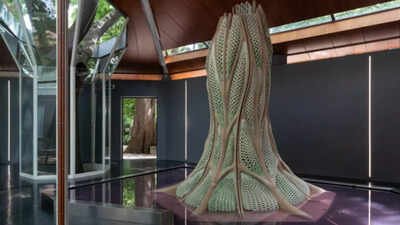
According to ArchDaily, at the 2025 Venice Architecture Biennale, visitors to the Canada Pavilion saw something unusual. The walls were soft, textured, almost organic. They were not just for show but these structures, called Picoplanktonics, were embedded with living cyanobacteria. That meant the installation required daily care. Light, temperature, humidity, all of it had to be just right. If the microbes failed, the structure itself would weaken. The pavilion was more like a greenhouse than a building. It seems strange to think of a wall needing attention, but that is exactly what makes the concept exciting. Architecture that lives. Architecture that breathes.So how does it actually work? Tiny cyanobacteria sit inside a printable hydrogel. They photosynthesise, turning sunlight and carbon dioxide into biomass. Over time, they grow and multiply, slowly changing the material around them. Within a month, samples gained roughly 36% more mass than non-living controls. That increase is the result of two processes. One is straightforward biological growth. The other is microbially induced carbonate precipitation, or MICP. The microbes create alkaline conditions that convert dissolved ions into solid minerals. Over time, those minerals build up, reinforcing the structure from the inside. The wall literally becomes harder as it ages.

Carbon capture and the surprising role of shape in living walls

This material does more than self-repair. It captures carbon. According to the research published in Nature, titled, ‘Dual carbon sequestration with photosynthetic living materials‘, early tests showed it absorbed about 2.2 milligrams of CO₂ per gram of hydrogel in the first month. It may not sound like much. But after over a year, the total stored carbon reached roughly 26 milligrams per gram, mostly in stable mineral form. It works slowly. Experts note that industrial systems are faster, but they also require energy and chemicals. This living wall works with sunlight and air. That simplicity might be valuable if it can scale up. Buildings could passively help fight climate change while still serving their normal functions.One surprising finding is that shape affects performance. Flat blocks of hydrogel are not ideal. They block light, limit airflow, and reduce bacterial activity. So researchers tried lattice structures, porous forms, even coral-inspired textures. Some designs increased volume while maintaining surface area. That allowed the cyanobacteria inside to stay active and healthy. The pavilion’s unusual look was not just for aesthetics. Every curve, every hole was functional. Living materials need space, light, and exchange to survive.



Source link

Sign Up For Daily Newsletter

Be keep up! Get the latest breaking news delivered straight to your inbox.
[mc4wp_form]
By signing up, you agree to our Terms of Use and acknowledge the data practices in our Privacy Policy. You may unsubscribe at any time.
Share This Article
Facebook Twitter Email Copy Link Print
Leave a comment Leave a comment

Leave a Reply Cancel reply

Your email address will not be published. Required fields are marked *

SUBSCRIBE NOW

Subscribe to our newsletter to get our newest articles instantly!

[mc4wp_form]

HOT NEWS

Mohit Patel: The Visionary Mind Behind MP Media, Monax, and The Popular Story

Mohit Patel: The Visionary Mind Behind MP Media, Monax, and The Popular Story

In the competitive era of digital media, branding, and youth culture, very few names are…

April 23, 2025
At AI Summit, PM Modi’s nameplate carries a ‘Bharat’ message | India News

At AI Summit, PM Modi’s nameplate carries a ‘Bharat’ message | India News

NEW DELHI: Prime Minister Narendra Modi on Thursday addressed the plenary session at the AI…

February 19, 2026
‘Who will pay for it?’: SC raps Tamil Nadu govt for promising free electricity; flags ‘freebie’ politics | India News

‘Who will pay for it?’: SC raps Tamil Nadu govt for promising free electricity; flags ‘freebie’ politics | India News

NEW DELHI: The Supreme Court on Thursday pulled up Tamil Nadu electricity board for promising…

February 19, 2026

YOU MAY ALSO LIKE

Hidden deep within the Swiss Alps, this structure was built with 60,000 stone slabs to disappear into the mountain and is now considered one of the greatest works of modern architecture | World News

Image Credit: By Micha L. Rieser Deep within the Swiss Alps, 1,200 metres above sea level, lies the small farming…

World
July 30, 2026

In 2001, scientists released beetles to fight an invasive tree. Years later, an endangered bird had lost 94% of its habitat along one western river | World News

The breeding grounds of the Southwestern Willow Flycatcher stretch across thousands of kilometres of rivers and streams in the American…

World
July 29, 2026

Two Ohio YouTubers behind Creek Kings Outdoors sentenced to jail after pleading guilty to 40 deer poaching charges, fined more than $37,000 and banned from hunting for five years | World News

Two Ohio YouTubers who built an online following by sharing hunting videos have been sentenced after admitting to dozens of…

World
July 28, 2026

First puffin chick in 30 years just emerged from England’s south coast after 15 weeks of careful monitoring, giving new hope to the country’s last mainland colony |

A tiny puffin chick has achieved something conservationists on England's south coast had not witnessed in three decades. After 15…

World
July 27, 2026
Copyright © 2020 MP Media All rights reserved.
Welcome Back!

Sign in to your account

Lost your password?