
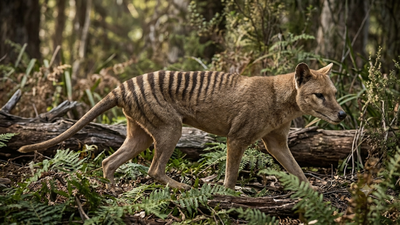

For decades, the Tasmanian tiger was portrayed as Australia’s most feared livestock predator. Farmers blamed it for dead sheep, newspapers described it as a menace to agriculture, and the Tasmanian government eventually paid cash rewards for its destruction. By the time the last known thylacine died at Hobart Zoo in September 1936, the species had vanished from the wild. Yet modern research suggests the animal may have been convicted in the court of public opinion long before the evidence was properly examined. Historical bounty records, population modelling, body-size analyses, and disease investigations now indicate that the thylacine’s reputation as a devastating sheep killer may have been greatly exaggerated. The real story behind the extinction of the Tasmanian tiger appears to be far more complicated and far more tragic.
More than 2,000 bounties were paid because farmers believed thylacines were killing sheep
The campaign against the thylacine intensified during the late nineteenth century as sheep farming expanded across Tasmania.From 1888 to 1909, according to official government records, more than 2,000 bounties had been paid out for thylacine kills. The thylacine was regularly blamed for large-scale livestock losses by farmers, stockmen, and politicians alike.The problem is that much of this reputation was built on assumption rather than direct observation.According to the Tasmanian Land Conservancy, many accusations were based on finding dead sheep and attributing the attack to a thylacine without confirming what predator had actually been responsible. Feral dogs, which were present across parts of Tasmania, were also capable of killing livestock and often left similar evidence behind.Adding to the debate is the animal’s size. Most adult thylacines weighed between 15 and 30 kilograms. While certainly capable predators, they were considerably smaller than many contemporary descriptions suggested.
New population models suggest hunting alone may not explain the collapse
A 2021 analysis examined more than 1,200 historical sighting records and reports associated with the species.Researchers from School of Natural Sciences, University of Tasmania, used statistical modelling to reconstruct the decline of the thylacine population and test different extinction scenarios. The results suggested that while bounty hunting undoubtedly reduced numbers, persecution alone struggled to explain the rapid and widespread disappearance observed across Tasmania.The study ‘Extinction of the Thylacine’ found evidence consistent with a population that was already under severe pressure by the early twentieth century.In some regions, sightings declined faster than would be expected if hunting had been the only factor involved. This raised the possibility that another process was acting alongside human persecution.
The disease theory centres on strange reports from the final decades
One of the most intriguing explanations comes from historical reports collected by researcher Robert Paddle under his study ‘The thylacine’s last straw: epidemic disease in a recent mammalian extinction.’In his review of thylacine extinction evidence, Paddle documented accounts describing animals that appeared unusually weak, thin, or unhealthy. Witnesses reported individuals suffering from hair loss and poor physical condition in areas where food resources should have been available.The pattern resembles what scientists might expect from an epidemic disease spreading through a small and fragmented population.While no biological samples exist that can conclusively prove a disease outbreak occurred, Paddle argues that epidemic illness remains one of the few explanations capable of accounting for the speed and geographical scale of the decline.Importantly, this theory does not replace hunting as a cause. Instead, it suggests that persecution may have struck a population already weakened by another threat.
The extinction of the Tasmanian tiger was probably a chain reaction
The image of the thylacine as a sheep-killing menace helped justify decades of organised persecution. Once bounties were introduced, every dead animal became another reason to eliminate the predator.Yet the evidence available today points towards a chain of events rather than a single cause. Hunting removed thousands of animals. Habitat pressures reduced available territory. Small populations became increasingly vulnerable. A disease outbreak may have further weakened survivors.The tragedy is that many of these questions were only investigated after the species had disappeared.By the time scientists began seriously examining whether the thylacine’s reputation matched reality, the world’s largest known carnivorous marsupial had already become an extinction icon. What remains is a cautionary lesson about how myths, economic fears, and incomplete evidence can shape the fate of an entire species.