
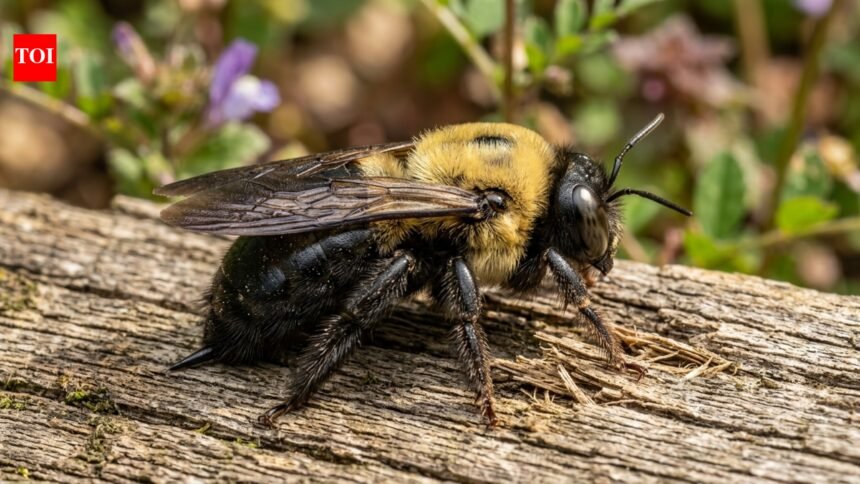

Every spring, like clockwork, they show up. You go out on your deck with your morning coffee, and there it is, a fat shiny bee hovering a bit too close to the railing, like it owns the place.Carpenter bees are one of those backyard realities that eventually most American homeowners have to deal with. This is especially true if you live in a place with older wood or a porch that has seen better days. They don’t attack. They are very interesting, but they will absolutely drill perfect little holes in your deck if you let them, and over time, that adds up to some real structural damage.So before you reach for the bug spray, here’s what’s really going on and what you can do about it.So what even is a carpenter bee?Carpenter bees are big and loud, and at first glance, they look almost identical to bumblebees. What’s the difference? Their abdomens are solid, shiny black, not fuzzy yellow stripes. They are solitary insects and thus don’t live in hives. Rather, each female makes her own tunnel in wood in which to lay her eggs. The males are the dramatic ones. If they feel threatened, they will hover right in your face and dive-bomb you. Terrifying, except they can’t sting.Here’s the part most people don’t know: those tunnels aren’t random. According to a study published in Ecology and Evolution, bees with wider mandibles were more successful at boring into harder wood, and longer tunnels lead directly to more offspring, so the female boring into your railing is making evolutionarily optimised choices about her home.The pollinator you didn’t know you neededCarpenter bees are important pollinators. They employ a technique called buzz pollination, where they vibrate their bodies at a particular frequency to dislodge pollen from flowers. The study, Buzz pollination: studying bee vibrations on flowers, found that about 6 per cent of all flowering plants use this mechanism. Beetles can’t do that, but carpenter bees can, and your backyard tomatoes and wildflowers are likely better off for it.The problem with your porchIf you notice perfectly round, dime-sized holes in your deck railings, siding or wooden furniture, you will know carpenter bees have moved in. Check under the ground; there is usually a small pile of sawdust. That is the female chewing through the wood to create her tunnel.
Carpenter bees, often mistaken for bumblebees, are solitary insects that drill perfect holes in wooden structures for nesting.
If they are not stopped, those tunnels grow. Bees return each season to build on existing nests. The holes allow moisture to enter, and rot to set in. Woodpeckers are quick learners and soon start going after the larvae inside, doing even more damage, and it turns into a whole thing.How to actually deal with them (without harming them)The good news is that you have options, and most are pretty low-effort.Paint and seal the wood. Carpenter bees are drawn to bare, unfinished, weathered wood, especially softer woods like pine, cedar and cypress. A fresh coat of exterior paint or sealant is a simple deterrent. It won’t guarantee anything, but it raises the barrier enough that bees will usually look elsewhere. Also, before you paint, fill in any nail holes or cracks with wood putty.Fill any existing holes. This is a big deal. Bees return to the same nesting sites every year and expand them. When the bees have gone for the season in the fall, fill any holes with wood filler, a wooden dowel, or even steel wool, then paint over them.Use almond oil. It sounds like an old wives’ tale, but carpenter bees really hate the smell of almond oil. If you rub it directly on wood surfaces in early spring, before bees return, it can help discourage them from settling in. It is water-soluble, so rinse it off and reapply as needed.Set a snare. Carpenter bee traps are available online and at hardware stores, and they actually work. They imitate a nesting site, draw the bees in and channel them into a jar. Best results are obtained when hung near problem areas in early spring.Give them another place to go. If bees are coming back to a specific location, move the affected board away from your house and replace it with a painted board. You can also stack untreated wood piles farther from your deck to act as a decoy nesting site. Plant some pollinator-friendly plants such as lavender, sunflowers and coneflowers, and you are pretty much sending them to a place where they are welcome.When all else failsIf the damage is already bad and you are worried about structural integrity, it’s worth calling in a pest control professional. They can evaluate the situation and provide specific treatment that limits harm to the bees while protecting your home.A little early spring prevention goes a long way. So, seal the wood, fill the old holes, and let these strange, harmless, ecologically useful bees find a better place to live.