
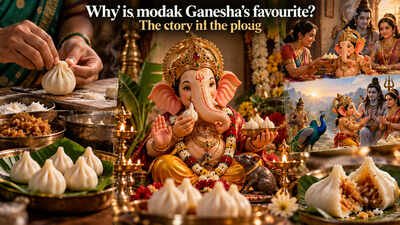

We’ve all eaten a modak once. The third pleat always gives it away. Pinch too hard, and the ukad, the steamed rice-flour dough that forms the modak’s outer shell, splits along the seam, and the coconut-jaggery filling starts leaking out before the thing even reaches the steamer.Every home cook who has attempted ukadiche modak, the hand-shaped version Maharashtrian households make for Ganesh Chaturthi, knows this exact dread. Usually, one of two things went wrong: the water wasn’t at a full rolling boil when the rice flour went in, or the filling was left too wet and is now fighting the covering meant to hold it.
Getting the Dough to Behave
Getting the ukad right is less about skill than heat. Rice flour, ideally a fine variety sold locally as ambemohar or flour milled specifically for modak, needs to hit water that is properly bubbling, with a spoonful of ghee and a pinch of salt already in it.Off the heat, the flour goes in all at once, gets covered, and rests for a few minutes so the steam can finish the job. Kneading happens while the dough is still uncomfortably warm, because cooled ukad turns stiff and won’t pleat.The filling, called saran or churan, is grated coconut and jaggery cooked down with cardamom until the moisture evaporates and it clumps rather than pools. Skip that reduction, and no amount of careful pleating will save you.None of this is a small ask on a weeknight, and most households skip the hand-pleated version fairly often. A plastic modak mould gets the shape right in seconds and is entirely respectable, even if it flattens the texture into something more uniform than fingers leave.Fried modak, the same filling in a maida crust, deep-fried instead of steamed, keeps for days and travels well to a pandal without going soggy. There’s no shame, either, in a box of mawa modaks from the sweet shop, made with khoya instead of coconut: sweeter, richer, entirely its own thing.What gets lost with each shortcut is mostly texture. The pillowy, translucent softness of a properly steamed casing is genuinely hard to fake.
Where the Word Comes From
Modaka comes from the Sanskrit moda, meaning joy or delight, so the word is less about ingredients than purpose.Go south, and the idea wears different names: kozhukattai in Tamil Nadu, kadubu in Karnataka, and, in Andhra and Telangana, undrallu or kudumulu, steamed rice dumplings offered at Vinayaka Chavithi, often savoury as well as sweet.
Twenty-One, and an Emptied Pantry
The most familiar story behind the sweet is a household one, told rather than scripted.Young Ganesha visits the ashram of the sage Anasuya, wife of Atri, alongside Shiva and Parvati, and eats his way through everything on offer without feeling full. Anasuya, watching the pantry empty, finally serves him one small modak, and that alone satisfies him, while Shiva is said to have burped in sympathy twenty-one times.It’s a popular telling, usually cited for why twenty-one modaks, and twenty-one blades of durva grass, became the traditional worship count. Some versions trace it to the Ganesha Purana or Mudgala Purana, but it’s better treated as folklore borrowing scriptural weight, rather than as a verse anyone can point to.
A Race, and a Different Prize
There’s a second, quite different story about a race.Ganesha and Kartikeya are offered a fruit of wisdom and told that whoever circles the world first gets to keep it. Kartikeya takes off on his peacock. Ganesha simply walks around his own parents, arguing that they contain the whole world within them, and wins.In most versions, especially in Tamil Nadu, the prize is a mango, or the gnana pazham, the fruit of wisdom, and the tale is tied to the Palani temple, where Kartikeya is said to have withdrawn afterward.Some North Indian retellings make the prize a modak containing amrita, the nectar of wisdom, and credit the Padma Purana, though that attribution is loose. The two prizes belong to separate regional traditions and shouldn’t be flattened into one.
What He’s Holding in His Hand
The sweet isn’t only a festival food. It appears in the worship texts themselves: the Ganapati Atharvashirsha describes offering modakas as part of devotion, and countless idols show Ganesha holding a modaka-patra, a bowl of modaks, with his trunk curving toward it.That’s iconography, not just kitchen tradition.Grandmothers offer a plainer explanation, no text required. Chaturthi falls as the monsoon eases into autumn, when appetites turn unpredictable, and a steamed shell of coconut and jaggery sits lighter than anything fried.As for the cracked one from this morning’s batch, it never makes it to the offering plate.It goes straight to whoever is standing closest to the stove.