
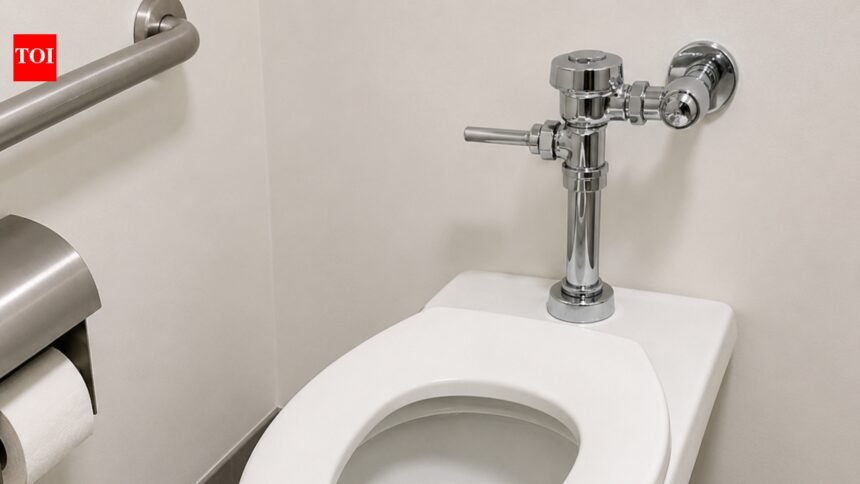

Most people have noticed it without ever really thinking about it. You walk into a public restroom at an airport, a mall, a highway rest stop, or a restaurant abroad, and the toilet seat is shaped like a U open at the front, missing a section that the toilet at home has. It looks a little odd. Some travellers assume it is broken, worn down, or just cheap. It is none of those things. The gap is there on purpose, and the reason goes back further than most people would expect. It is rooted in decades-old plumbing codes, hygiene science, and a deliberate effort to make public restrooms safer and easier to maintain.
The public toilet seats gap design rooted in plumbing code, not cost
The U-shaped open-front toilet seat became official policy in the United States in 1955, when the American Standard National Plumbing Code first mandated the design for public restrooms. In 1973, the International Association of Plumbing and Mechanical Officials (IAPMO) reinforced it through the Uniform Plumbing Code, which has since been adopted in whole or in part by municipalities across the country and influenced restroom standards in many other parts of the world. These plumbing codes are not laws in themselves, but most local governments simply adopt their standards directly. The gap, in short, is not a cost-cutting measure. It exists because someone decided it should, and wrote it into the rulebook.
Why the U-shaped toilet seat was designed
The primary reason behind the open-front design is hygiene and specifically, the hygiene needs of women. Lynne Simnick, senior vice president of code development at the IAPMO, has explained that the gap is meant to allow women to wipe the perineal area after using the toilet without making contact with the front of the seat. With a full oval seat, that contact is essentially unavoidable. The U-shape removes the problem entirely by removing the surface itself.The design also reduces the total area of the seat that skin comes into contact with during use, which matters enormously in a high-traffic public restroom where dozens or hundreds of people are cycling through the same stall every day. Less surface contact means fewer opportunities for germ transfer, regardless of how recently the seat was cleaned.
Why the open-front design is better for restroom cleaning and sanitation
Beyond the individual user, the open-front design has practical benefits for the people tasked with keeping public restrooms sanitary. The gap gives cleaning staff easier access to the front rim of the bowl and the underside of the seat areas that are notoriously difficult to reach with standard cleaning tools on a full oval seat. In busy environments like airports or transit hubs, where restrooms are cleaned on tight schedules, that accessibility makes a real difference in how thoroughly a toilet can be sanitised in a short window of time.There is also an airflow benefit. The open design allows for better ventilation around the seating area, which helps reduce lingering odours, and is a small but noticeable improvement in environments that see constant use throughout the day.
What international travellers often get wrong about public toilet designs
For travellers moving between countries, the variation in restroom design can be genuinely confusing. In much of the United States, the open-front U-seat is standard in any public facility. In the United Kingdom, many public toilets go further, foregoing the seat altogether, primarily to deter theft and vandalism. In parts of Europe and Asia, squat toilets remain common, where the question of seat design is moot entirely.It is also worth knowing that disposable paper toilet seat covers, common in American airports and frequently sought out by hygiene-conscious travellers, offer less protection than most people assume. They were not designed as a germ barrier. They were designed as a psychological comfort measure, and most bacteria can pass through them easily. The gap in the seat, counterintuitively, does more for hygiene than the paper cover placed over it.
A small toilet seat detail that carries a surprisingly large purpose
There is something quietly interesting about the fact that a design feature used by hundreds of millions of people every day was put there for a reason most of them have never been told. The U-shaped toilet seat is not a quirk of public infrastructure, or a sign that public facilities are inferior to private ones. It is a deliberate, regulated, and reasoned choice that prioritises hygiene, ease of cleaning, and user comfort in environments where all three are harder to maintain.The next time you land at an unfamiliar airport and make your way to the terminal restroom, you will know exactly why the seat looks the way it does. And that, for a frequent traveller, is one less mystery to carry through the departure gate.