
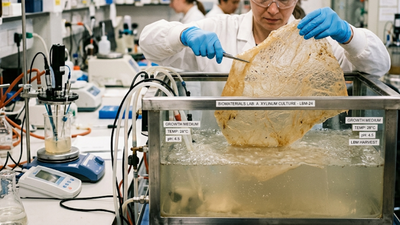

Plastic pollution, biodegradable materials and sustainable manufacturing are becoming major priorities for scientists worldwide, and researchers in the United States may have found a breakthrough solution. Scientists at Rice University and the University of Houston have created a new bacteria-grown supermaterial using bacterial cellulose that is strong, flexible and environmentally friendly. Published in Nature Communications, the research shows how aligned cellulose nanofibres can produce a high-performance material capable of replacing plastic in packaging, electronics and manufacturing. Researchers believe the innovation could help reduce microplastic pollution while transforming green manufacturing, bioengineering and sustainable industrial design across multiple industries.
How scientists created the new bacteria-grown supermaterial
The key aspect of the innovation is related to bacterial cellulose, which is a natural biopolymer generated by particular types of bacteria. Although cellulose is present in plants, bacterial cellulose is known for being one of the purest forms in nature. Scientists invented a rotating bioreactor that helps to direct bacteria’s movement in a certain direction while generating cellulose fibres.As noted in the paper titled ‘Flow-induced 2D nanomaterials intercalated aligned bacterial cellulose,’ the alignment significantly boosts the performance of the material. Specifically, the artificial cellulose sheets were able to withstand tensile forces of up to 436 megapascals, which makes them as strong as metals and glass but at the same time lightweight, flexible, and transparent. “The bacteria move in all directions; we tell them to move in a certain direction,” stated M.A.S.R. Saadi, the lead author of the research. Scientists additionally introduced boron nitride nanosheets to boost the material’s performance. As a result, the improved material was capable of dissipating heat three times faster than traditional cellulose sheets.
Why bacterial cellulose could replace traditional plastics
It is reported that scientists have observed that traditional plastics continue to cause serious environmental challenges since they decompose into microplastics and emit toxic compounds such as BPA and phthalates. In contrast to petroleum-based plastics, bacterial cellulose is biodegradable and sourced from natural sources.Muhammad Maksud Rahman, assistant professor of mechanical and aerospace engineering at the University of Houston, stated that the team envisions that “strong, multifunctional and eco-friendly bacterial cellulose sheets become ubiquitous”.The potential of the material is being noticed by researchers due to its unique blend of properties. It is strong like industrial material, lightweight like plastic and eco-friendly at the same time. Scientists feel that in future, it can be used for food packaging, flexible electronics, textiles, thermal management systems, and energy storage devices.The global research community is increasingly looking for biodegradable substitutes for plastics. Bio-based structural materials are becoming increasingly important in minimising reliance on fossil fuel plastics.
Could sustainable supermaterials change modern manufacturing
Perhaps the most important aspect of the discovery is its scalability. It is often difficult for eco-friendly materials to go from experimental tests to practical applications because of their high manufacturing costs. However, according to researchers, this bacterial cellulose process can be implemented in just one manufacturing step and scaled up to an industrial scale.While on one hand, the sustainability of the material is praised, on the other hand, doubts have been expressed regarding its economic viability in comparison to cheaper petroleum-based plastics.Nevertheless, scientists are hopeful that this experiment will prove to be a significant milestone towards green manufacturing. Rather than manufacturing materials from crude oil, we might be able to produce materials in the future with the help of bacteria.Plastics have always been the go-to option for manufacturers because they are cheap and easy to manufacture. But it appears that the future of manufacturing lies in cultivating supermaterials using bacteria.