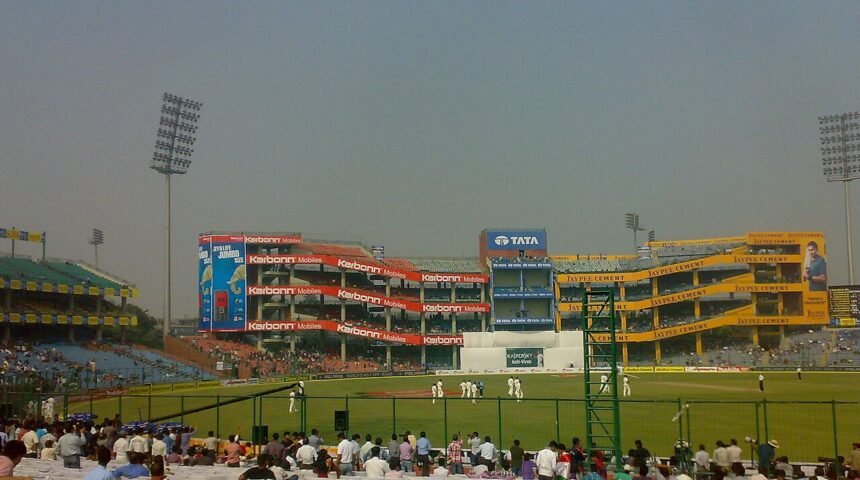
International cricket is played in three main formats: Test matches, One Day Internationals (ODIs) and Twenty20 Internationals (T20Is). They follow the same basic Laws of the game, but differ in length, strategy and the way a result is reached.
Photo credit: Vineetmbbs, CC BY-SA 3.0, via Wikimedia Commons.
Test cricket
A Test match is played over up to five days, with each side batting twice. There is no limit on the number of overs in an innings. To win, a team must bowl the opposition out twice and score more runs overall, which means taking 20 wickets. If time runs out first, the match is drawn. Tests are traditionally played in white clothing with a red ball.
One Day Internationals
An ODI is a limited-overs match in which each side bats once and faces a maximum of 50 overs. The team that scores more runs wins. A single bowler can bowl no more than 10 overs. The first ODI was played in Melbourne in January 1971, and the format led to the Cricket World Cup, first held in 1975.
Twenty20 Internationals
T20 is the shortest format. Each side bats once and faces 20 overs, so a match is usually finished in about three hours. A bowler can bowl at most four overs. The first men’s T20 international was played in 2005, and the first T20 World Cup was held in 2007.
Fielding restrictions
Limited-overs formats limit how many fielders can stand outside the inner circle in the early overs. In T20 this applies to the first six overs, and in ODIs to the first 10, which encourages attacking batting at the start of an innings.
Which format is which?
- Test: up to five days, two innings each, no over limit.
- ODI: 50 overs per side, one innings each.
- T20I: 20 overs per side, one innings each.
Sources: Laws of Cricket (MCC) and International Cricket Council playing conditions. Written by The Popular Story desk. Playing conditions can change, so check the ICC site for the latest rules.