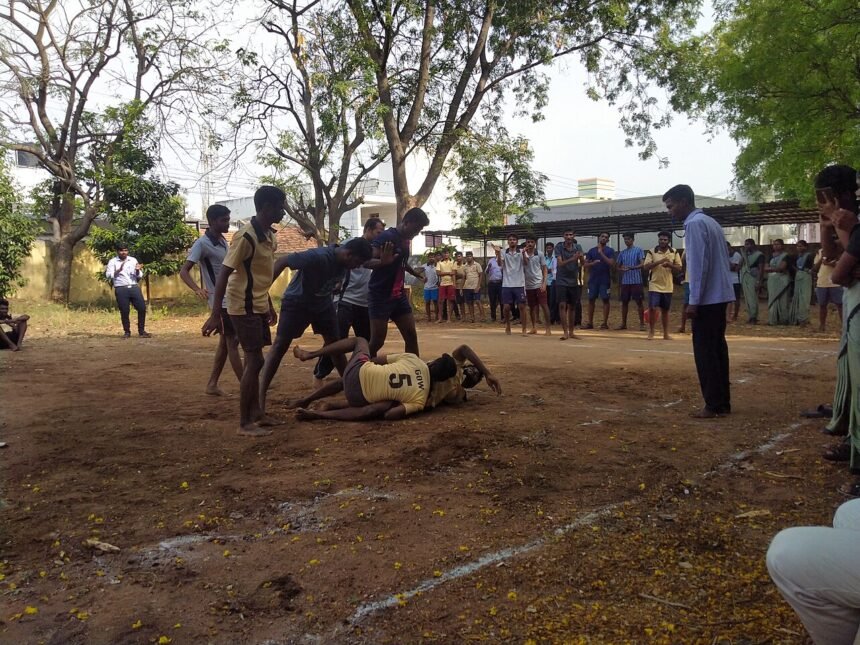
Kabaddi is a full-contact team sport that is believed to have originated in the Indian subcontinent. Here is a simple guide to how it is played.
The basics
- Each side has seven players on the mat, with three to five substitutes.
- The men’s court measures 10 x 13 metres and the women’s court 8 x 12 metres, divided by a midline.
- A match has two halves of 20 minutes for men and 15 minutes for women, with a five-minute break.
How a raid works
One player, the raider, enters the opposing half and tries to tag defenders and return to their own side without being tackled. The raider must chant “kabaddi” in a single breath during the raid. Each defender tagged scores a point for the raiding team. The defenders score a point if the raider is tackled, steps out of bounds or runs out of time.
Bonus point and All Out
A raider can earn a bonus point by stepping over the bonus line when six or more opponents are on court. When a team puts out all seven opponents, it gets two extra points, which is called an “All Out”, and the players re-enter. Outed players come back as their team scores.
Tie-breakers
If the match is tied, each team gets five raids. If it is still level, a “golden raid” decides the winner.
History
The first rules were drawn up in present-day Maharashtra in 1921 and modified in 1923. Kabaddi was a demonstration sport at the first Asian Games in New Delhi in 1951 and became a medal event in 1990 in Beijing. India has won seven of the eight men’s Asian Games gold medals, while Iran won both golds in 2018.
Pro Kabaddi League
The Pro Kabaddi League began in 2014 with eight franchises and grew to 12 teams before the 2017 season. It introduced rules such as the do-or-die raid, the super raid (three or more points in a raid), the Super Ten (10 or more points by a raider) and the High Five (five tackles by a defender).
Source: Wikipedia. Photo: Sumathiraju, CC BY-SA 4.0, via Wikimedia Commons.