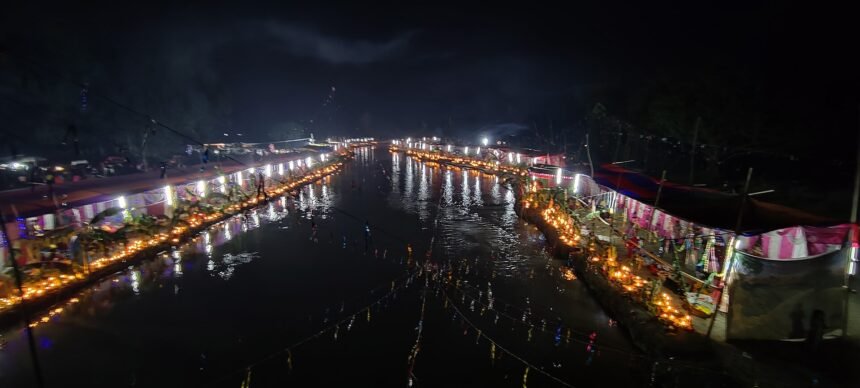
Chhath is one of the few festivals where there is no idol and often no priest. There is the Sun, a river or pond, a bamboo soop full of thekua and fruit, and a vratin standing in the water. That simplicity is a big part of why the festival means so much to families from Bihar, Jharkhand, eastern Uttar Pradesh and Nepal’s Terai, and why you now see Chhath ghats from Mumbai to Dubai.
This year, Chhath Puja runs from Friday, November 13 to Monday, November 16, 2026.
Chhath Puja 2026: the four days
| Day | Date | Ritual |
|---|---|---|
| Nahay Khay | Friday, November 13 | Holy bath, cleaning the home, one sattvic meal |
| Kharna (Lohanda) | Saturday, November 14 | Day-long fast, broken after sunset with prasad |
| Sandhya Arghya | Sunday, November 15 | Offering to the setting sun |
| Usha Arghya and Parana | Monday, November 16 | Offering to the rising sun, then the fast ends |
Arghya timings by city
The arghya is offered at sunset on Sunday and sunrise on Monday, so the exact time depends on where you are. These timings are based on Drik Panchang data (IST):
| City | Sandhya Arghya (Nov 15) | Usha Arghya (Nov 16) |
|---|---|---|
| Patna | 5:01 PM | 6:07 AM |
| Gaya | 5:03 PM | 6:07 AM |
| Muzaffarpur | 4:59 PM | 6:07 AM |
| Bhagalpur | 4:54 PM | 6:00 AM |
| Ranchi | 5:04 PM | 6:03 AM |
| Varanasi | 5:10 PM | 6:16 AM |
| Kolkata | 4:53 PM | 5:50 AM |
| Delhi | 5:28 PM | 6:44 AM |
| Mumbai | 6:00 PM | 6:46 AM |
If you are abroad, follow your own city’s sunset and sunrise. Most families reach the ghat well before the time anyway, since getting into the water and settling the soop takes a while.
What happens on each day
Nahay Khay
The festival begins with purification. The vratin bathes, ideally in a river or pond, and the house is cleaned thoroughly. Only one meal is eaten, usually lauki (bottle gourd) sabzi, chana dal and rice cooked without onion or garlic.
Kharna
On the second day, the vratin fasts from sunrise. After sunset, rasiao kheer, made with rice, milk and jaggery, is cooked along with roti, traditionally on a clay chulha using mango wood. The vratin eats first, and then the prasad is shared with family and neighbours. This is also when the toughest part begins: a nirjala fast of about 36 hours, without water.
Sandhya Arghya
On the third evening, the family walks to the ghat carrying soops and daura (baskets) filled with thekua, sugarcane, coconut, bananas and seasonal fruit. Standing in the water, the vratin offers arghya to the setting sun. Folk songs of Chhath fill the ghats, and in many towns this is the most crowded evening of the year.
Usha Arghya and Parana
Before dawn on the last day, everyone returns to the ghat. Arghya is offered to the rising sun, prayers are said for the family, and the vratin breaks the fast with prasad. Thekua, the jaggery and wheat biscuit pressed in a wooden mould, is shared with anyone who comes by.
Why Chhath is different
Chhath honours Surya Dev and Chhathi Maiya. It is the only major festival where the setting sun is worshipped as well as the rising one, a quiet reminder that both ends of the day matter. The rituals ask for discipline rather than spending: clean hands, home-made prasad and patience in cold water.
A note on the fast
A 36-hour waterless fast is demanding. If you are pregnant or breastfeeding, have diabetes, heart, kidney or blood pressure problems, are elderly or take regular medicines, speak to a doctor first. Many families accept a modified fast, or simply join the arghya without fasting. The devotion counts just as much.
Dates and timings based on Hindutone (Drik Panchang data) and NewsBytes. Local panchang timings may differ by a minute or two.
Featured image: Image: Pustam.EGR, via Wikimedia Commons (CC BY-SA 4.0).