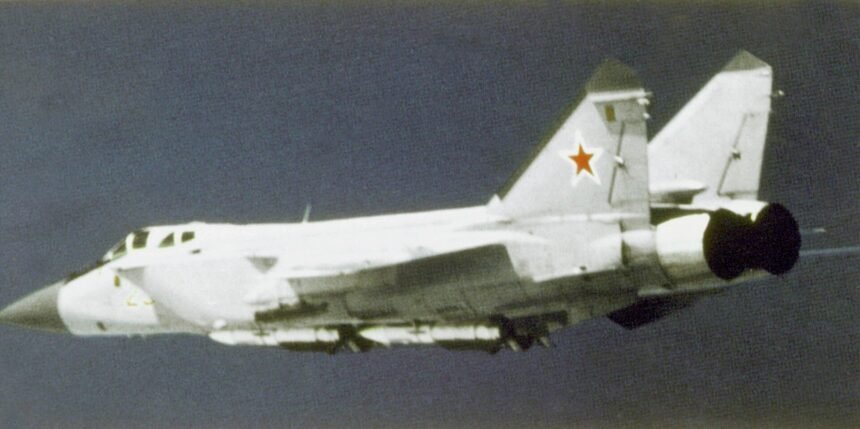
Ukraine says its Savasleyka air base strike has knocked five Russian combat jets out of action, hitting one of the airfields Moscow uses to launch hypersonic missiles. Ukraine’s General Staff announced on Wednesday, 25 November, that three MiG-31 interceptors and two Su-34 fighter-bombers were damaged at the base in the Nizhny Novgorod region, east of Moscow.
Russia had not commented on the claim when it was reported by Reuters, and the damage figures have not been independently confirmed.
What Ukraine claims about the Savasleyka air base strike
According to the General Staff, the operation ran from 24 November into the early hours of 25 November. Its preliminary assessment said the five aircraft would be unable to fly “for some time.” Kyiv did not say what weapons it used or describe the exact damage.
The same statement listed other targets: a Russian P-18 surveillance radar near Karavan-Solodkyi in occupied Luhansk, and fuel, logistics and ammunition depots in occupied eastern Ukraine.
Why this base matters
Savasleyka is not an ordinary airfield. It hosts MiG-31K jets configured to carry the Kh-47M2 Kinzhal, an air-launched ballistic missile Russia has fired repeatedly at Ukrainian cities and infrastructure. Kinzhal missiles are fast and hard to intercept, so every aircraft able to carry them is a high-value target for Kyiv.
The Su-34s, meanwhile, are used to drop glide bombs on front-line positions. Taking even a few out of service for a period can ease pressure on Ukrainian troops.
Has Savasleyka been hit before?
Yes. Ukraine reported attacks on the base in August 2024, when media cited intelligence sources claiming aircraft were destroyed or damaged, though that was never verified. On 9 June 2025, Kyiv said two more aircraft were damaged there. Repeat strikes suggest Ukraine sees the airfield as a priority, and that Russia has struggled to fully protect it.
Part of a wider long-range campaign
The claim fits a pattern of deep strikes over recent weeks. Reuters reported that:
- Two Russian ships were hit in Libyan waters and another vessel in the Gulf of Finland.
- Last week, Ukraine knocked out the road section of the bridge to Crimea, a strike we covered in our report on the Crimean Bridge attack.
- Defence Minister Yevhenii Khmara said Ukraine has hit 16 Russian ballistic-missile launchers over several months.
- Industry sources said Ukrainian drone attacks have cut Russian refinery processing by 45% since late October.
What is still unclear
Several details are missing. Kyiv has not released images of the damaged jets, and it has not said whether drones, missiles or another method were used. “Knocked out for some time” could mean anything from a few weeks of repairs to a much longer loss. Russia’s defence ministry often reports shooting down drones over its regions without confirming damage on the ground, so a full picture may take days and may depend on independent satellite imagery.
What it means for peace talks
The strikes come during a renewed US-backed peace push, and both sides appear to be trying to strengthen their hand before any deal. Kyiv says it will stop hitting Russian energy sites only when Moscow does the same. The two sides recently held a prisoner exchange alongside talks in Abu Dhabi, as reported in our earlier story, but there is still no ceasefire.
For India, which buys large volumes of Russian crude, the bigger long-term question is the steady pressure on Russian refineries and shipping, which can affect fuel exports and freight costs. A single airfield strike will not change that on its own.
Reporting based on Reuters via The Standard and The Defense Watch.
Featured image: Unknown, via Wikimedia Commons (Public domain)