
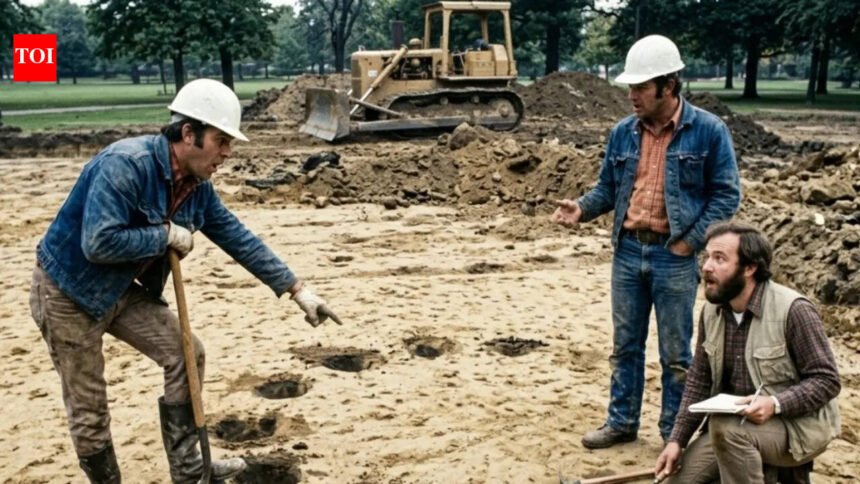

A routine project led to the discovery of a lost ancient fort settlement. The first clue of the archaeological find came in 1971 when construction workers in Dayton, Ohio, began preparing a site for a new park. As they started digging the ground, they noticed peculiarities on the surface – post holes. They were the signs of wood, which decomposed over time.Soon after being accidentally discovered by construction workers, the place earned the name SunWatch Indian Village. It turned out to be the location of a Fort Ancient Native American village hidden underneath for hundreds of years.How archaeologists identified SunWatch Indian VillagePost holes have always played an essential role in archaeological digs. Once wooden structures disintegrate, the ground still preserves the stain. The pattern can help scientists determine the position of buildings, storage, and entire villages.It was a fortunate coincidence that such marks were well-preserved at the SunWatch Indian Village site. According to the University of Dayton, the site dates back to 1200 CE and represents a long-term Indigenous community in the area.The location of the ancient village also plays a key role. The village itself was situated near the Great Miami River, and this territory was considered a part of the Indigenous cultural landscape by the National Park Service in Ohio.Why SunWatch has historical significanceSunWatch can hardly be considered a mere dig site. Instead, it stands as an example of an entire civilisation living in the Ohio region prior to European colonisation. In this place, the Fort Ancient culture raised its families, grew crops, and formed organised communities.According to the National Park Service, SunWatch is considered a partly reconstructed village. Therefore, this site provides sufficient information on the lives of the people who lived here almost 1,000 years ago. It is worth mentioning that many archaeological sites have not been sufficiently preserved or excavated to provide researchers with such a wealth of data.
Scientists determined the position of buildings, storage, and entire villages. Image credit – Gemini
What the burial evidence showedApart from houses and artefacts, archaeologists found a graveyard. This discovery gave researchers additional insights into the lives of people who inhabited SunWatch.A study examined the teeth of 166 people buried at the location. According to researchers, they all belonged to one biological community, but some differences indicated contact with other groups.These findings confirm that SunWatch existed as an interconnected and dynamic society. It did not exist in isolation. Individuals entered and left the region, enriching its cultural heritage.Understanding Fort Ancient society betterFort Ancient societies formed an integral part of the SunWatch community. Their settlements spread through some parts of present-day Ohio and its neighbouring areas. They cultivated crops, organised themselves into societies, and built settlements.SunWatch gives us an accurate portrayal of this society. The site’s spatial configuration, burial artefacts, and environmental data help historians reconstruct daily activities. It reveals how people used space, managed resources, and created social order.Its association with one particular time period makes it easier to understand what life looked like back then.From farmland to heritage siteAfter its discovery, SunWatch has become a fully protected archaeological site. Now, it is officially known as SunWatch Indian Village and Archaeological Park.Such a change involved considerable work on preserving and studying the discovery. First, researchers have managed to study the site. Second, the park itself has been constructed. Nowadays, people can visit the recreated Indian village and learn its history.At the moment, the National Park Service considers SunWatch to be one of the key sites of the Indigenous people in Ohio.The significance of SunWatch’s discoveryIt lies in the fact that it clearly shows how many discoveries can be buried under ordinary land. During a long period of time, the area was used for agriculture, but there was nothing to suggest the existence of an important archaeological site.The discovery of SunWatch is also important since it shows how modern human activities may help people learn more about the history of the country. The scientific value of the site is also high since researchers continue to study the structure, burial records, and environment of SunWatch.History from below the groundThe accidental discovery of the SunWatch Indian Village was initially a fluke. However, its influence endures to this day. The construction project led to the excavation of an extensive historical record detailing the lifestyle of an indigenous society in the Miami Valley.In reality, history is always waiting for us underneath the surface. Under certain circumstances, history can come to light through the process of excavation, and with it a new understanding of our collective heritage.