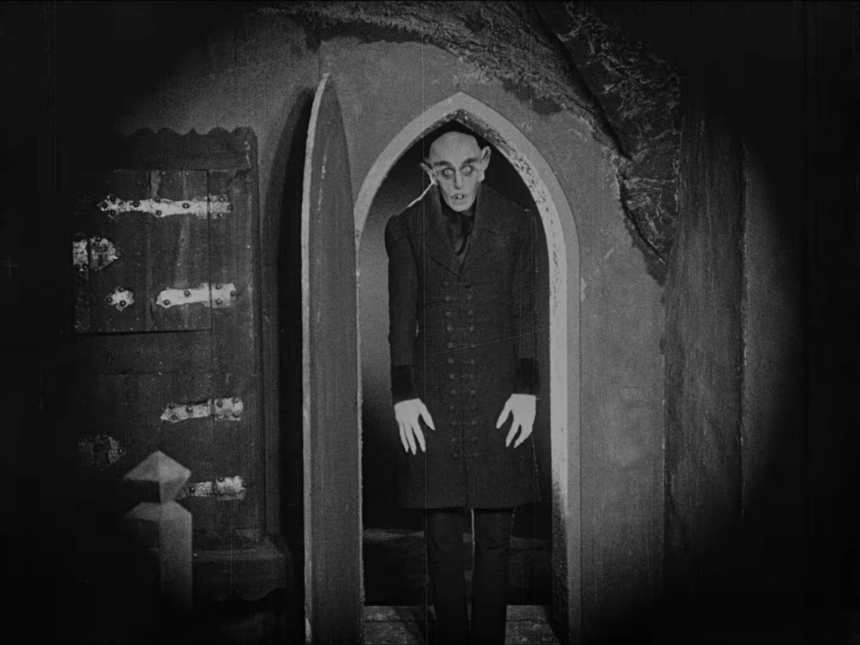
One of the starkest images in F.W. Murnau’s Nosferatu is a man standing inside a doorway. Count Orlok is upright and still. The opening frames his pale face and makes the surrounding darkness feel like a place he could step out of. There is little movement to distract the eye. Much of the scene’s force comes from the time we spend waiting to learn whether he will cross the threshold.
The 1922 film has accumulated more than a century of interpretations. The British Film Institute’s account identifies Max Schreck as Orlok and describes the film as an unofficial adaptation of Bram Stoker’s Dracula. The BFI also points to a major change in the story: the vampire arrives in town with rats and an outbreak of disease. An audience watching the film itself can see the change in scale. Trouble first seems confined to a room and later spreads through the town.
A frame within the frame
Doorways are useful to a filmmaker because they divide what we can see. We can observe where a figure stands and still know almost nothing about the space behind them. A figure placed frontally in an opening can also appear momentarily flat, almost like a picture hung inside the shot. A step towards the camera restores depth all at once. That change can feel dramatic even when the person is moving slowly.
Orlok’s appearance carries some of the effect. His posture and relatively spare movements encourage us to pay attention to the shape of his body. A doorway reinforces that shape. It also gives us a scale for judging distance. The audience can tell when the body approaches an edge or occupies more of the opening. If the camera cut away immediately, that work would be lost. Waiting allows the audience to become aware of how little protection a frame offers.
How the threat travels
The film gives Orlok several ways to appear. A ship can carry him over a distance. A building can offer him an opening. A shadow can travel up a wall before we see the body responsible for it. Each kind of movement alters what the audience knows. A ship suggests a journey that has consequences beyond one house. A shadow brings the threat close while giving only partial information about the figure moving nearby.
Follow the change from one kind of space to another during a viewing. The castle rooms, the ship and the town offer different sightlines. Some scenes give the viewer a broad view of where trouble is coming from. Others restrict the view to a single entrance or the outline of a hand. The recurring question is whether the person inside the scene can see as much as the audience. When the answer changes, the emotional balance changes too.
Which print are you seeing?
The experience can vary with the score, intertitles and print. The BFI notes that a court ordered prints destroyed after Stoker’s widow won a copyright dispute, and that copies survived. The version linked above is identified as a later restoration. If you compare two editions, check the credits before assuming a difference in tint or sound was present in every early screening.
The doorway image holds attention across those differences. The figure, the opening and the darkness behind it give a viewer a precise spatial problem. The scene leaves enough time to imagine what the next step might do. That patience explains part of the film’s continuing pull. For current screenings and film discussion, see The Popular Story’s Entertainment coverage.
One revealing comparison is between an open entrance in daylight and an opening with Orlok inside it. Both give the eye a boundary. Timing and the actor’s position determine whether we read the opening as an invitation or a threat.
Featured image: F. W. Murnau’s Nosferatu (1922), via Wikimedia Commons. Image source. Reuse terms.