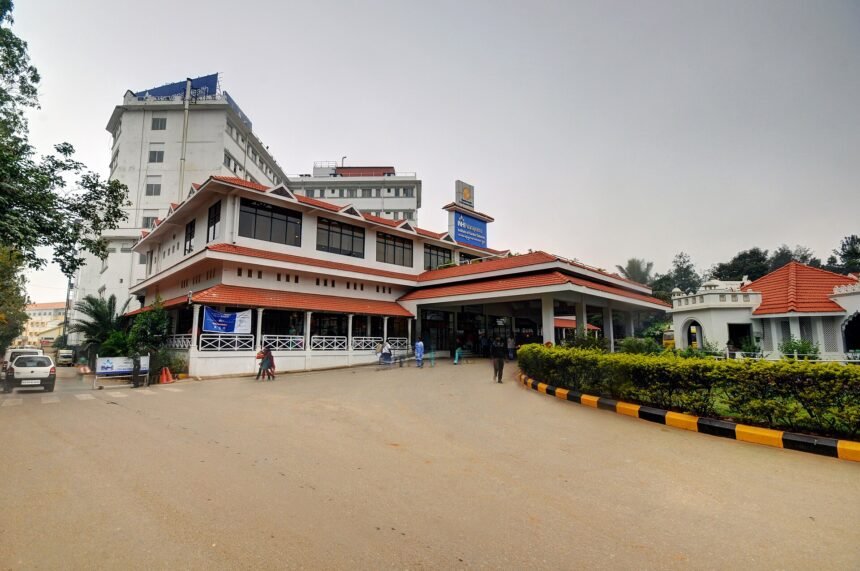
At the end of October 2026, Narayana Hrudayalaya reported its results for the July to September quarter. Consolidated revenue rose 73% year on year to ₹2,844 crore, helped by the first full contribution from its new UK hospital business. Profit after tax came in at ₹301.2 crore. For a company that started as a single cardiac hospital on the edge of Bengaluru in 2001, it was another sign of how far the model built by Dr Devi Prasad Shetty has travelled.
The early years
Shetty was born on 8 May 1953 in Kinnigoli, in Karnataka’s Dakshina Kannada district, the eighth of nine children. As a schoolboy he read about Christiaan Barnard’s first heart transplant and decided he wanted to be a heart surgeon.
He studied at St Aloysius High School in Mangalore and finished his MBBS in 1979 at Kasturba Medical College, where he also trained in general surgery. He then went to England, earned his FRCS from the Royal College of Surgeons and trained in cardiothoracic surgery at Guy’s Hospital in London.
He came back to India in 1989 and joined B.M. Birla Hospital in Kolkata. In 1992 he performed what is recorded as the country’s first neonatal heart surgery, on a 21-day-old baby. In Kolkata he also operated on Mother Teresa after her heart attack and later served as her physician.
The idea
The question that bothered him was simple. Why should good heart care depend on how much money a patient has? He has said his “only objective was to bring down the cost of heart care for the common man in the country,” in an interview with Business Today in 2025.
His father-in-law, the construction businessman Charmakki Narayana Shetty, offered to fund a hospital. The first one, the Rabindranath Tagore International Institute of Cardiac Sciences in Kolkata, opened in 2000. A year later, in 2001, Narayana Hrudayalaya opened as a 225-bed cardiac hospital in Bommasandra, on the outskirts of Bengaluru.
How the model works
Shetty borrowed a lesson from manufacturing: do the same complex task many times, and both quality and cost improve. Surgeons at his hospitals have been reported to perform 30 to 35 operations a day. The Wall Street Journal once called him “the Henry Ford of heart surgery.”
The numbers show the effect. According to Business Today (2025), a heart surgery at Narayana Health costs about ₹1.5 to 2 lakh, against up to ₹30 lakh in the United States. The group has also spent around ₹600 crore on its own digital platform, and uses robotics and AI-based diagnostics to reduce its dependence on scarce, high-cost specialists.
He also worked on the demand side. With the Karnataka government he designed Yeshasvini, a low-cost health insurance scheme for farmers. In January 2024 the group’s own insurer, Narayana Health Insurance, received its licence from IRDAI.
The hard part
Cheap care only works if the hospital stays financially healthy. Narayana went public in January 2016 at ₹250 a share. Reuters reported that the stock opened at ₹291 on debut, but the business still had to prove that low prices and steady profits could go together.
Margins in hospitals are thin, beds take years to fill, and expansion is capital heavy. Narayana built a large hospital in the Cayman Islands to serve patients from the Caribbean and the US, and the UK move in 2025 added fresh costs. In the latest quarter, integration-related expenses pulled the consolidated EBITDA margin down to 21.3% from 25.9% a year earlier.
How it grew
By 2025, Business Today counted 42 healthcare facilities in India with 5,098 operational beds. In FY24, the group reported consolidated revenue of ₹5,018 crore and profit after tax of ₹790 crore.
In October 2025 it agreed to buy Practice Plus Group Hospitals in the UK for £188.78 million (about ₹2,200 crore) in an all-cash deal. The chain has 12 hospitals and surgical centres and performs about 80,000 operations a year. Shetty called it “an incredibly exciting step” for the company.
Where it stands now
In the September 2026 quarter, revenue excluding the UK grew 22.6% to ₹2,015.6 crore, and the India hospital business posted an EBITDA margin of 26.8%. International patient revenue in India rose 75.7%. Day-to-day operations are led by Managing Director and Group CEO Dr Emmanuel Rupert.
Shetty has received the Padma Shri (2004) and the Padma Bhushan (2012) for his work on affordable healthcare.
Lessons for founders
- Pick one problem and stay with it. For over two decades, the target has been the cost of a procedure.
- Volume can be a quality strategy. Repetition made surgeons better and fixed costs smaller per patient.
- Fix the system, not only the product. Insurance schemes and digital tools helped patients reach the hospital and pay for care.
- Growth brings new costs. Expansion abroad lifts revenue first and profits later, and investors watch that gap closely.
Reporting based on Business Today (2025), Kotak Neo on Q2 FY27 results, Business Today on the UK acquisition, Reuters via Business Standard and Wikipedia.
Featured image: GeorgeWilliams21, via Wikimedia Commons (CC BY-SA 4.0)