
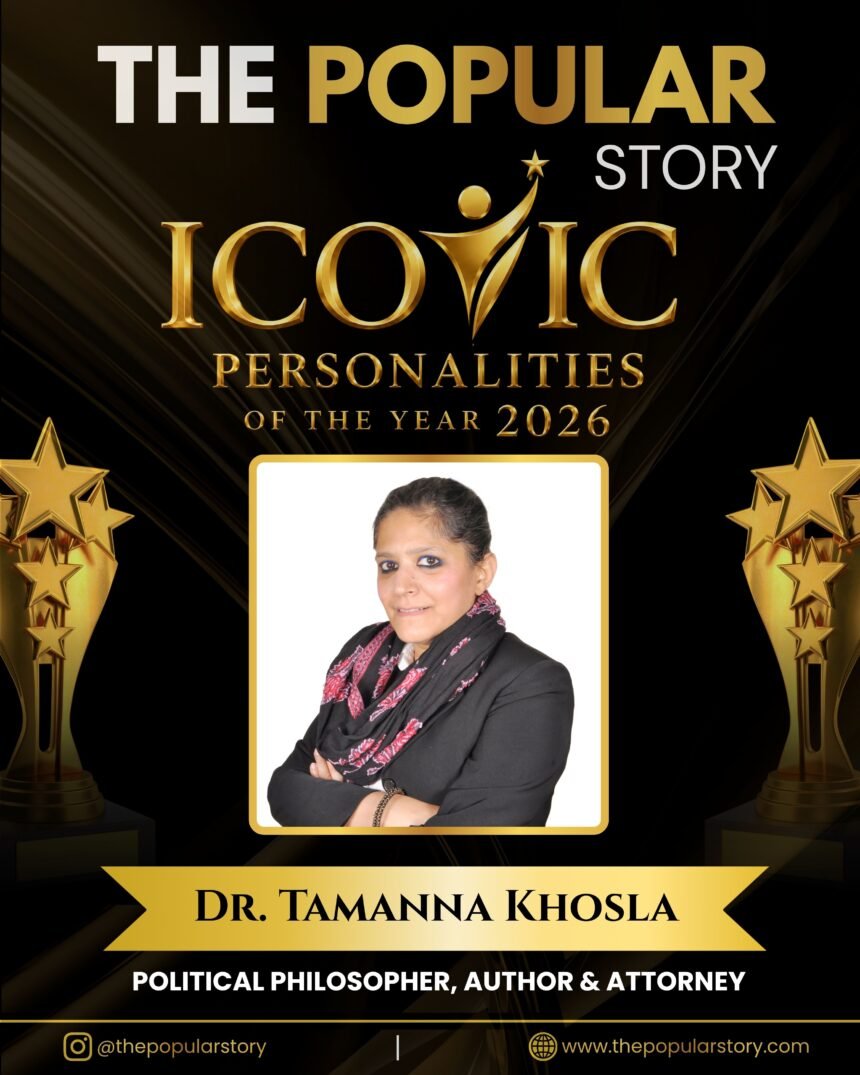
Some intellectual journeys are defined by a single discipline. Dr. Tamanna Khosla’s journey stands apart because it crosses several—political science, philosophy, law, gender studies, governance, international relations and social thought. An academic, attorney, author, researcher, political philosopher and public intellectual, she has built her career around one enduring objective: using knowledge to understand complex social challenges and explore pathways towards a more equitable and intellectually progressive society.
Her curiosity began early. Born into a middle-class family in New Delhi to an artist father and homemaker mother, Dr. Khosla developed a fascination with science and the mysteries of existence as a child. She recalls building paper telescopes and observing the stars, nurturing an early dream of becoming a scientist. That curiosity would eventually evolve into a much broader intellectual journey spanning disciplines that are often studied separately.
Her academic foundation was established at Lady Shri Ram College, where she completed her Bachelor’s degree in Political Science. She subsequently pursued her Master’s, M.Phil. and Ph.D. at Jawaharlal Nehru University (JNU). Her doctoral research examined the relationship between multiculturalism and feminism, particularly the challenge of reconciling cultural diversity with gender equality.
This academic work later developed into her acclaimed book, Personal Law in India: Reconciling Cultural Diversity with Gender Equality. The work positioned her within important conversations around political theory, legal philosophy, gender studies and the relationship between individual rights and cultural traditions.
Her professional journey, however, was not without difficulties. Institutional challenges eventually forced her to leave academia, creating a period of financial and professional uncertainty. Rather than allowing these circumstances to end her intellectual pursuits, Dr. Khosla used the period as an opportunity to expand her research and writing.
Over approximately eight years, she authored more than ten books, exploring subjects including feminism, Hinduism, individualism, governance, democracy, international relations, astro-philosophy, legal systems and the future of human civilisation. Several of her works were translated into major European languages, allowing her ideas to reach audiences beyond India.
Her intellectual interests have never been confined to conventional academic boundaries. Recognising the relationship between law and social justice, she went on to earn an LL.B., adding legal education to her already diverse academic background. This strengthened her belief that disciplines such as law, science, philosophy, technology, governance and spirituality can contribute to understanding and addressing humanity’s most difficult challenges.
For Dr. Khosla, interdisciplinary thinking is not simply an academic concept. It is a practical necessity. Social problems rarely fit neatly within the boundaries of one subject. Questions surrounding healthcare, inequality, women’s empowerment, environmental sustainability, governance and technological change often require perspectives from multiple fields working together.
This philosophy is now shaping her most ambitious undertaking—the proposed establishment of a multidisciplinary research and knowledge organisation. The envisioned institution aims to bring together scholars, scientists, doctors, technologists, policymakers and thinkers on a common platform.
The organisation is intended to explore research across areas including natural and social sciences, law, philosophy, technology, governance, women’s empowerment, legal reform, animal welfare, emerging technologies, space studies and future societies. Its broader objective is to develop knowledge-driven approaches to issues such as inequality, healthcare, sustainability, governance and humanitarian challenges.
What distinguishes Dr. Khosla’s vision is the emphasis on collaboration rather than isolated expertise. She believes meaningful progress can emerge when different intellectual traditions engage with one another and challenge established assumptions.
Her journey also reflects resilience. The professional setbacks she experienced could have narrowed her ambitions, but instead they became part of a period of significant intellectual productivity. Her continued writing, research and pursuit of interdisciplinary knowledge demonstrate a willingness to keep learning even when conventional career paths become uncertain.
Today, Dr. Tamanna Khosla continues to advocate for intellectual freedom, ethical leadership and research-driven social transformation. Her work encourages a broader understanding of knowledge—one that values scientific inquiry while also recognising the contributions of philosophy, law, social sciences and other forms of thought.
From a young girl fascinated by the stars to an internationally recognised scholar, author, legal thinker and visionary entrepreneur, her journey is defined by curiosity, resilience and an unwillingness to remain within conventional boundaries.
Through her scholarship, writing and vision for a collaborative research ecosystem, Dr. Tamanna Khosla continues to explore how knowledge can be used to address the challenges facing society and humanity. Her interdisciplinary perspective and commitment to intellectual exploration make her a deserving honouree in The Popular Story’s Iconic Personalities of the Year 2026.