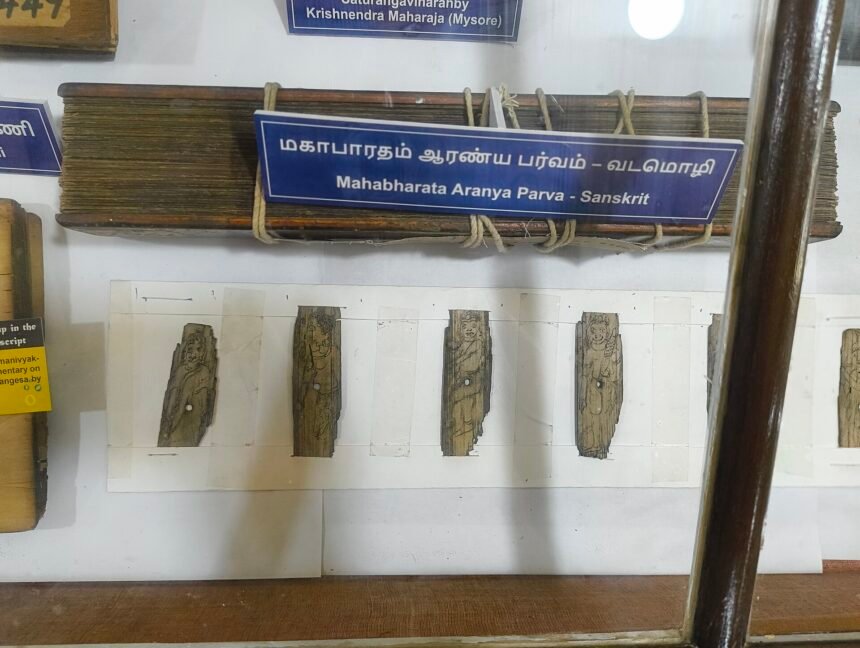
Three of India’s best-known ancient texts have received fresh international recognition. Manuscripts of the Mahabharata, Kautilya’s Arthashastra and Kalhana’s Rajatarangini have been added to UNESCO’s Memory of the World Asia-Pacific Regional Register.
The decision was taken at the 11th session of the register’s committee in Jakarta, Indonesia, held from November 2 to 6. It was announced in New Delhi on November 5, with PIB Culture calling it “a moment of immense pride for India.”
Where the manuscripts are kept
The inscribed manuscripts are held at three institutions known for their collections of rare texts:
- Bhandarkar Oriental Research Institute, Pune
- Oriental Research Library, Srinagar
- Oriental Research Institute, Mysuru
The Indira Gandhi National Centre for the Arts (IGNCA), under the Ministry of Culture, prepared the nomination dossiers.
Why these three texts
Each covers very different ground. The Mahabharata is the great epic, and much of Indian storytelling, philosophy and moral debate flows from it. The Arthashastra is a treatise on governance, economics and statecraft, still studied by students of political science and strategy. The Rajatarangini, written by Kalhana in the 12th century, is a chronicle of the kings of Kashmir and is often described as one of the earliest works of history writing in India.
What the register means
The programme runs at two levels. There is an international register, and there are regional registers, including the one for Asia and the Pacific, which is managed by a regional committee known as MOWCAP. The texts announced this week have been added at the regional level.
UNESCO set up the Memory of the World programme in 1992 to protect documentary heritage, from manuscripts to archives and recordings. Being on the register does not bring money directly, but it does raise the profile of a collection and encourages better preservation and digitisation.
With these additions, India’s entries on the Asia-Pacific regional register go up from three to six. In April 2025, manuscripts of the Bhagavad Gita and Natyashastra were added to UNESCO’s international Memory of the World register.
For the institutions holding these manuscripts, the recognition is also a reminder of the work involved in keeping fragile palm-leaf and paper pages readable for another few hundred years.
Reporting based on ThePrint (PTI) and official announcements by PIB Culture.
Featured image: Image: Info-farmer, via Wikimedia Commons (CC BY-SA 4.0).