In October 2026, Infosys reported revenue of about Rs 49,244 crore (USD 5.14 billion) for the July to September quarter, with net profit up 6.2% to roughly Rs 7,838 crore. It also trimmed its full-year growth outlook to 1% to 2% in constant currency, a sign of how cautious global clients still are. Not bad for a company that once waited two years for its first computer.
The story of Infosys is closely tied to N. R. Narayana Murthy, its first chief executive, and the six engineers who started it with him in 1981.
The early years
Murthy was born on 20 August 1946 in Sidlaghatta, a small town in Karnataka, into a middle-class family. He studied electrical engineering at the National Institute of Engineering in Mysuru, graduating in 1967, and completed a master’s degree at IIT Kanpur in 1969.
His first job was at IIM Ahmedabad, first as a research associate and later as chief systems programmer. There he worked on a time-sharing computer system and wrote a BASIC interpreter for Electronics Corporation of India Limited. He then tried running his own company, Softronics. It closed after about a year and a half. He moved to Patni Computer Systems in Pune, where he met several of the people who would later start Infosys with him.
The idea
On 2 July 1981, Infosys Consultants Private Limited was registered in Pune. The founders were Narayana Murthy, Nandan Nilekani, Kris Gopalakrishnan, S. D. Shibulal, K. Dinesh, N. S. Raghavan and Ashok Arora. The starting capital was Rs 10,000, which came from the savings of Murthy’s wife, Sudha Murty. The first office was their home in Pune.
The plan was to write software in India for clients abroad. In 1981, with a tightly controlled economy and scarce foreign exchange, that was a bold bet.
The hard part
Basic infrastructure was the first wall. Importing a computer meant repeated trips to Delhi, banks would not lend against software, and a phone line could take years. Nandan Nilekani later told The Week that “it took us over two years to get our very first computer.”
For several years Infosys had one main customer, Data Basics Corporation in the US. The team built software for its apparel manufacturing package and shipped installation disks to America, which took around two weeks each time.
In 1984, when customs officials asked for a bribe to clear an imported minicomputer, Murthy refused. He told his manager to pay the 135% duty and appeal for a refund instead. It was an expensive choice, and it set the tone.
There were missteps too. A move into hardware between 1985 and 1987 did not work out and was sold. In 1989, the founders received an offer of USD 1 million for the whole company. They said no. “Fortunately, we decided to continue,” Kris Gopalakrishnan recalled years later.
How it grew
Infosys moved its base to Bengaluru in 1983. In 1985 it started work on banking software, which grew into its Finacle product. By 1987 it had more clients and had opened sales offices in the US.
The company went public in India in February 1993 at Rs 95 per share. In March 1999 it listed its American depositary receipts on Nasdaq, the first Indian company to do so. Murthy is widely credited with shaping the global delivery model, where much of the work for overseas clients is done from India. Time and CNBC have called him the “father of the Indian IT sector.”
Murthy was CEO from 1981 to 2002, when Nilekani took over. He later served as chairman and chief mentor, retired in August 2011, returned as executive chairman in June 2013, and stepped back again in 2014. He has received the Padma Shri (2000) and the Padma Vibhushan (2008).
Where it stands now
Today Infosys is run by CEO and managing director Salil Parekh, in the role since January 2018. The company had 328,594 employees as of March 2026 and reported annual revenue of about Rs 1,78,803 crore for fiscal 2026. In its latest quarter, AI-related work made up about 10.5% of revenue, according to figures reported with the results.
Growth is slower than in the boom years, as the October 2026 guidance cut shows, but Infosys remains one of India’s largest listed companies.
Lessons for founders
- Small capital is not the end. Infosys began with Rs 10,000 and a home office. What mattered more was a team with complementary skills.
- Say no to the easy exit if you still believe. Turning down USD 1 million in 1989 looks obvious now. At the time it was a real gamble.
- Values cost money in the short run. Paying full customs duty instead of a bribe hurt cash flow, but it built a reputation that clients and investors trusted.
Reporting based on Staffing Industry Analysts, The Week, Infosys company history and N. R. Narayana Murthy biography.
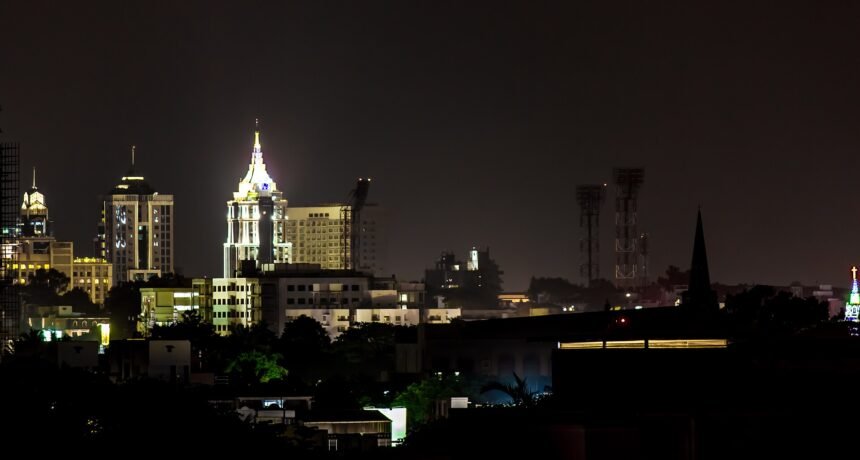
Featured image: Saad Faruque from Bangalore, India, via Wikimedia Commons (CC BY-SA 2.0)