The Popular Story
  • About Us
  • Articles
  • Success Stories
  • Contact Us
  • About UsArticlesSuccess StoriesContact Us
HomeTop NewsEntertainmentSportsLifestyleAstrologyWorld
Magazine
All IssuesIconic Personalities of the Year 2026July 2026 | The Business Visionaries EditionThe Popular Story 40 Under 40Top 50 Iconic Personalities of 2026
Lists
40 Under 40Top 50 Iconic PersonalitiesIconic Personalities of the Year
Connect+
InstagramFacebookXYouTubeLinkedIn
All Categories
HomeTop NewsEntertainmentSportsLifestyleAstrologyWorldMagazine40 Under 40Top 50 Iconic PersonalitiesIconic Personalities of the YearAbout Us
Font ResizerAa
The Popular StoryThe Popular Story
Search
Follow US
Copyright © 2025-2026 MP Media. All rights reserved.
The Popular Story > Entertainment > Why the Doorways in Nosferatu Still Make Us Uneasy
EntertainmentTop News

Why the Doorways in Nosferatu Still Make Us Uneasy

By Mohit Patel Last updated: November 20, 2026 5 Min Read
Share
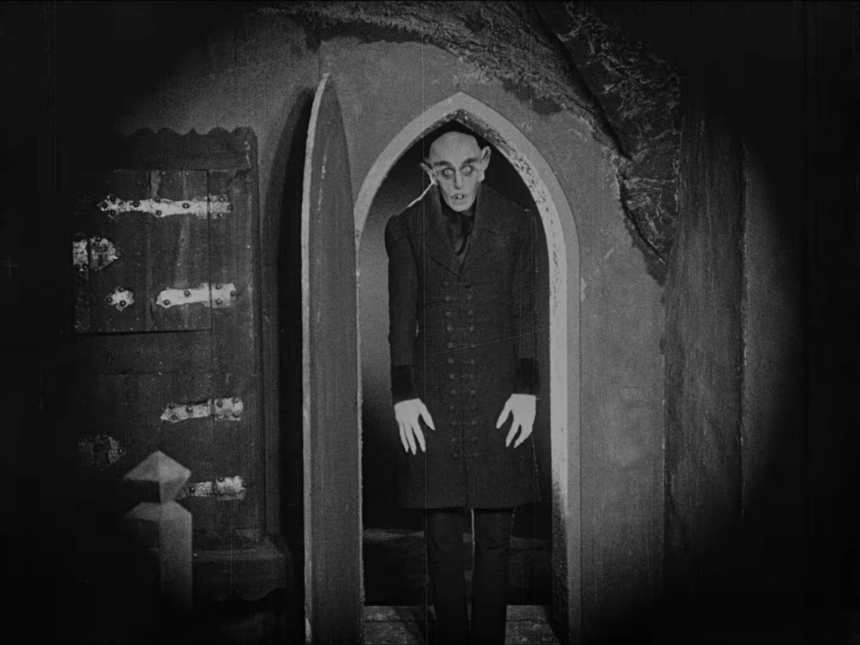
Count Orlok stands almost motionless in an arched doorway, his face and hands lit against dark clothing.
Max Schreck as Count Orlok, framed by a doorway in F. W. Murnau’s Nosferatu (1922). Image credit: F. W. Murnau’s Nosferatu (1922), via Wikimedia Commons.

One of the starkest images in F.W. Murnau’s Nosferatu is a man standing inside a doorway. Count Orlok is upright and still. The opening frames his pale face and makes the surrounding darkness feel like a place he could step out of. There is little movement to distract the eye. Much of the scene’s force comes from the time we spend waiting to learn whether he will cross the threshold.

Contents
A frame within the frameHow the threat travelsWhich print are you seeing?

The 1922 film has accumulated more than a century of interpretations. The British Film Institute’s account identifies Max Schreck as Orlok and describes the film as an unofficial adaptation of Bram Stoker’s Dracula. The BFI also points to a major change in the story: the vampire arrives in town with rats and an outbreak of disease. An audience watching the film itself can see the change in scale. Trouble first seems confined to a room and later spreads through the town.

A frame within the frame

Doorways are useful to a filmmaker because they divide what we can see. We can observe where a figure stands and still know almost nothing about the space behind them. A figure placed frontally in an opening can also appear momentarily flat, almost like a picture hung inside the shot. A step towards the camera restores depth all at once. That change can feel dramatic even when the person is moving slowly.

Orlok’s appearance carries some of the effect. His posture and relatively spare movements encourage us to pay attention to the shape of his body. A doorway reinforces that shape. It also gives us a scale for judging distance. The audience can tell when the body approaches an edge or occupies more of the opening. If the camera cut away immediately, that work would be lost. Waiting allows the audience to become aware of how little protection a frame offers.

How the threat travels

The film gives Orlok several ways to appear. A ship can carry him over a distance. A building can offer him an opening. A shadow can travel up a wall before we see the body responsible for it. Each kind of movement alters what the audience knows. A ship suggests a journey that has consequences beyond one house. A shadow brings the threat close while giving only partial information about the figure moving nearby.

Follow the change from one kind of space to another during a viewing. The castle rooms, the ship and the town offer different sightlines. Some scenes give the viewer a broad view of where trouble is coming from. Others restrict the view to a single entrance or the outline of a hand. The recurring question is whether the person inside the scene can see as much as the audience. When the answer changes, the emotional balance changes too.

Which print are you seeing?

The experience can vary with the score, intertitles and print. The BFI notes that a court ordered prints destroyed after Stoker’s widow won a copyright dispute, and that copies survived. The version linked above is identified as a later restoration. If you compare two editions, check the credits before assuming a difference in tint or sound was present in every early screening.

The doorway image holds attention across those differences. The figure, the opening and the darkness behind it give a viewer a precise spatial problem. The scene leaves enough time to imagine what the next step might do. That patience explains part of the film’s continuing pull. For current screenings and film discussion, see The Popular Story’s Entertainment coverage.

One revealing comparison is between an open entrance in daylight and an opening with Orlok inside it. Both give the eye a boundary. Timing and the actor’s position determine whether we read the opening as an invitation or a threat.

Featured image: F. W. Murnau’s Nosferatu (1922), via Wikimedia Commons. Image source. Reuse terms.


Subscribe to Our Newsletter

Subscribe to our newsletter to get our newest articles instantly!

[mc4wp_form]

Sign Up For Daily Newsletter

Be keep up! Get the latest breaking news delivered straight to your inbox.
[mc4wp_form]
By signing up, you agree to our Terms of Use and acknowledge the data practices in our Privacy Policy. You may unsubscribe at any time.
Share This Article
Facebook Twitter Email Copy Link Print
By Mohit Patel
Follow:
Mohit Patel is an Indian entrepreneur, digital marketing professional, and Founder & CEO of MP Media Promotion. With expertise in public relations, media outreach and brand building, he helps businesses and personalities strengthen their visibility. He also founded The Popular Story, a magazine platform highlighting inspiring individuals and emerging talent across India.
Leave a comment Leave a comment

Leave a Reply Cancel reply

Your email address will not be published. Required fields are marked *

SUBSCRIBE NOW

Subscribe to our newsletter to get our newest articles instantly!

[mc4wp_form]

HOT NEWS

A movie camera on a tripod

IFFI’s Films About Films Section Turns the Camera on Cinema Itself

The International Film Festival of India has added a section devoted to films about the…

November 19, 2026
Technicians in white protective suits stand around the Roman Space Telescope in a clean room.

NASA Sets 7 December for the Roman Space Telescope’s First Images

NASA plans to unveil the first images from the Nancy Grace Roman Space Telescope on…

November 20, 2026
A bright exhaust plume pours from an engine mounted on the Fred Haise Test Stand.

NASA Fires an Artemis Development Engine for 200 Seconds in Mississippi

An RS-25 engine burned for three minutes and 20 seconds at NASA’s Stennis Space Center…

November 20, 2026

YOU MAY ALSO LIKE

How Charlie Chaplin Uses Slapstick to Build a Family in The Kid

Charlie Chaplin’s Tramp and Jackie Coogan’s child make a persuasive family in The Kid because we get to see them…

EntertainmentTop News
November 20, 2026

How Georges Méliès Made the Moon a Stage for Early Cinema

The Moon has a face in Georges Méliès’s A Trip to the Moon. That is enough to tell us what…

EntertainmentTop News
November 20, 2026

How to Measure How Much Water Your Shower Uses

Shower water is hard to count while it is running down a drain. If you want to know whether a…

LifestyleTop News
November 20, 2026

How to Spend an Hour in a Museum Without Rushing Through It

Museums make it easy to feel behind before you have seen anything. There may be three floors, a temporary exhibition…

LifestyleTop News
November 20, 2026
Copyright © 2025-2026 MP Media. All rights reserved.

About Us

The Popular Story is a digital magazine and news publication bringing you stories from entertainment, sports, lifestyle, astrology and the world, with a focus on clear, original and reliable reporting.

Quick Links

  • About The Popular Story
  • Privacy Policy
  • Terms and Conditions
  • Disclaimer
  • Editorial Policy
  • Corrections Policy
  • Our Team

Follow us on Social Media

Explore

  • Contact Us
  • Entertainment
  • Sports
  • Lifestyle

Latest Magazine

View Magazine
© 2026 The Popular Story. All rights reserved.Privacy
Welcome Back!

Sign in to your account

Lost your password?