The Moon has a face in Georges Méliès’s A Trip to the Moon. That is enough to tell us what kind of voyage we are taking. A projectile strikes the face in the eye, turning a journey that could have ended in a neat landing into a comic injury. Even a viewer familiar with the famous image can find more to enjoy by watching how the rest of the 1902 film uses scenery, movement and the changing distance between the audience and its performers.
The film survives in versions that differ in length, accompaniment and colour. The black-and-white version on Wikimedia Commons lets viewers follow the action from the planning room to the return to Earth. The Museum of Modern Art’s collection entry places it alongside the imaginative voyages of Jules Verne and H. G. Wells and discusses Méliès’s use of sets and screen effects.
The picture is arranged to be read from a distance
Méliès often gives the viewer a full view of the action. People move in groups, signal agreement or opposition with their arms and appear at different positions across the set. You can follow where attention shifts by watching who turns to face the person speaking or who steps into an open space. It is a form of direction that often resembles theatre. The viewer sees a whole group organise itself before the film moves to the next scene.
The fixed viewpoint also gives the set an active job. It can suggest the height of a ledge or the depth of a cavern while keeping the performers visible. A group of travellers can enter a scene and show us what matters by breaking ranks or gathering around it. The frame has space for several responses at once. Rewatch one scene and look at the person farthest from its apparent centre. Their movement often gives the composition some of its life.
When the camera does what a stage cannot
Then the film uses changes that would be difficult to produce in the same way before an audience seated in a theatre. A figure can disappear suddenly. A new image can appear by gradual transition. The Moon can come towards the viewer and occupy the frame. A change in scale becomes a change in the story. The audience moves from observing a plan made by a group to confronting a face whose expression feels close enough to read.
That flexibility is part of the joke. In the planning room, the Moon is a destination. In the famous image, it has an eye that can be hurt. When the travellers explore the surface, the setting again behaves like a place where bodies can move. The film lets several ideas about the same object coexist. Its freedom to change the rules helps explain why people still return to the picture even when they already know its best-known moment.
A useful way to watch the journey again
Follow the edges of the frame. Notice where people enter and where they go when the film wants you to feel that they have travelled. Then watch for a transition that skips a step the performers could otherwise have acted out. The difference reveals how Méliès distributes the work between staging and editing. The performers show us impatience, panic or excitement. A cut or effect can send them somewhere those reactions suddenly make a different kind of sense.
The film is short enough to try both kinds of viewing in one sitting. For another example of filmmakers turning the camera’s possibilities into a subject, see The Popular Story’s guide to IFFI’s Films About Films programme.
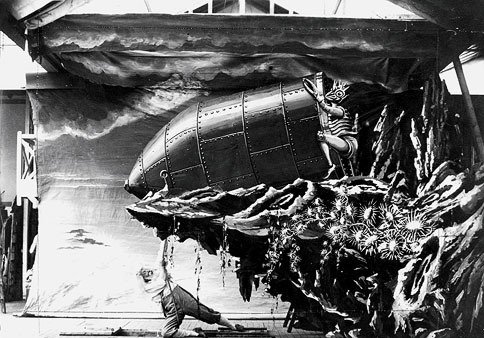
The accompanying production still makes the arrangement visible in another way. It shows the studio floor and the edge of a backdrop that the finished film could leave beyond the frame.
Featured image: Georges Méliès, via Wikimedia Commons. Image source. Reuse terms.