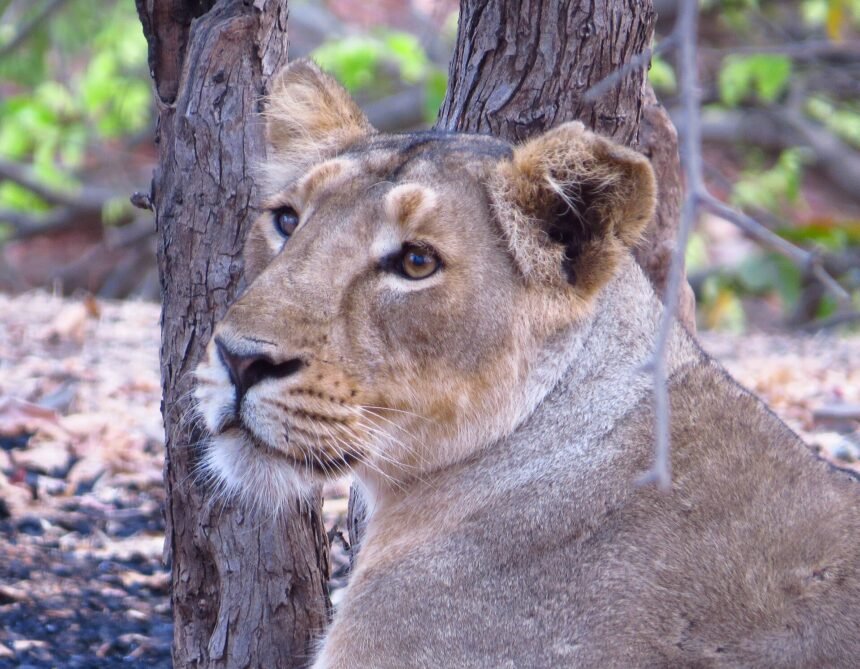
Two Asiatic lionesses were killed when a passenger train hit them on a railway line in Jetpur taluka on the evening of November 23. The case of the lionesses killed by train in Rajkot district has worried forest officials because, by their account, nothing like it had happened on this stretch before.
Lionesses killed by train in Rajkot: where it happened
The accident took place around 8 pm on Monday, November 23, between Vavdi and Khirsara stations on the Jetalsar-Dhasa broad-gauge section. The train was the Bhavnagar-Porbandar Passenger (No. 59560), running towards Porbandar.
Both animals, estimated to be about three years old, died on the spot. “Both were killed on the spot,” Range Forest Officer Hiren Ratanpara told PTI. He added that “the train was travelling at a high speed” when the lionesses came onto the tracks.
The train stood at the site for well over an hour before moving again. Gujarat Samachar reported that word spread quickly through nearby villages and crowds gathered along the line.
What forest officials have said
Ratanpara described the area as one with “a permanent presence of around five to seven lions” and said such an incident had never been reported there before. The stretch is not an officially notified lion corridor, but it lies in a movement zone near the Girnar forest, and lions from Amreli district also pass through.
Rajkot Deputy Conservator of Forests Yuvrajsinh Jhala told reporters that further action would follow the standard operating procedures agreed between the Forest Department and the Railways.
Reports differ slightly on what happened next. DeshGujarat, citing preliminary information, said three lions were in the area and the forest team was searching for the third. PTI quoted officials as saying no other lions were seen nearby, and that trackers had been sent out. The carcasses were sent for post-mortem, and officials are working to identify the pride the lionesses belonged to.
Why railway tracks are a known danger
Train hits are not new for Gujarat’s lions. Several deaths over the past decade happened on lines in Amreli and the Pipavav port area, many involving goods trains. After those incidents, the state and the Railways put in place measures on sensitive stretches, such as speed limits, trackers who watch for lions near the tracks, and fencing at some points.
The Jetpur accident is different in one way. It happened on a line that was not part of that high-alert map. Lions in Saurashtra have spread well beyond Gir over the last 15 years, into farmland, river belts and scrub in Rajkot, Amreli, Bhavnagar and Junagadh districts. Protection measures drawn around older corridors may not cover every place the animals now use.
A difficult week for Gujarat’s lions
The Jetpur deaths came within days of another worrying report. Gujarat Samachar reported on November 26 that four newborn cubs had died at Sakkarbaug Zoo in Junagadh. Their mother had reportedly been moved there from the Girnar forest ahead of the Lili Parikrama pilgrimage and was said to be under stress. The Forest Department’s response to that report was not available at the time of writing.
Earlier in the year, DeshGujarat reported two lionesses found dead in separate cases, one electrocuted by an illegal farm fence. Each case has a different cause, but together they point to the same pressure: more lions living close to people, roads and railways.
What to watch next
- Post-mortem findings and the Forest Department’s account of how the lions reached the track
- Whether the Railways set speed limits or add lion trackers on the Jetalsar-Dhasa section
- Any decision to treat the Jetpur area as a lion movement zone under the existing SOP
Readers interested in how other Indian predators cope with human-dominated land can read our piece on the conservation challenges facing the Indian grey wolf, which deals with many of the same problems.
Reporting based on PTI via Telangana Today, DeshGujarat, Gujarat Samachar and Gujarat Samachar (Junagadh).
Featured image: Anil B. Patel, via Wikimedia Commons (CC BY-SA 4.0).