In 1966, a 21-year-old engineering student at Stanford got a phone call that changed his life. His father, Muhammed Hashim Premji, had died suddenly in Bombay, and someone had to run the family company. The Azim Premji success story starts there: a young man with no business experience taking charge of a vegetable oil maker in a small Maharashtra town, and turning it, over five decades, into Wipro.
A vanaspati company in Amalner
The business was Western India Vegetable Products Ltd, set up in 1945, the year Azim Premji was born. It made vanaspati and other oil products from a factory in Amalner, in Jalgaon district. When Premji took over in 1966, it was a modest regional firm.
He left his Stanford degree unfinished to come home. He would complete it decades later by distance learning. In the meantime he learned the business on the job, expanding into soaps and other consumer products. The company was renamed Wipro Products in 1977 and simply Wipro in 1982, according to a Business Standard timeline.
The turn to computers
The real opportunity came from outside. In the late 1970s IBM left India after a dispute over rules on foreign ownership. That left a gap in the Indian computer market, and around 1980 Wipro moved into making computers and then into software services.
It was a strange bet for an oil and soap company. It also turned out to be the right one, just as global firms began looking to India for software talent. Wipro moved its headquarters from Mumbai to Bengaluru in 1996, listed on the New York Stock Exchange in 2000, and by 2004 had become a billion-dollar company.
The consumer business did not disappear. The Santoor range grew into one of India’s best-known brands, and Wipro’s consumer arm still runs alongside the IT business.
Premji has been open about how messy that kind of growth is. “It is impossible to generate a few good ideas without a lot of bad ideas,” he said at Stanford’s business school in 2006. “Failure should be forgiven and forgotten quickly.”
Wipro today
In the financial year that ended March 31, 2025, Wipro reported gross revenue of Rs 89,090 crore, roughly US$10.4 billion, and net income of Rs 13,140 crore, according to its results release. The company describes itself as having more than 230,000 employees and business partners across 65 countries.
Premji stepped back as executive chairman on July 30, 2019, after 53 years, and his son Rishad took over. In his farewell letter to employees he wrote: “Leading Wipro from 1966 till now has been the greatest privilege of my life.”
Giving most of it away
What sets Premji apart from most Indian billionaires is what he did with the money. He set up the Azim Premji Foundation in 2001 to work with government schools. In 2013 he became the first Indian to sign the Giving Pledge.
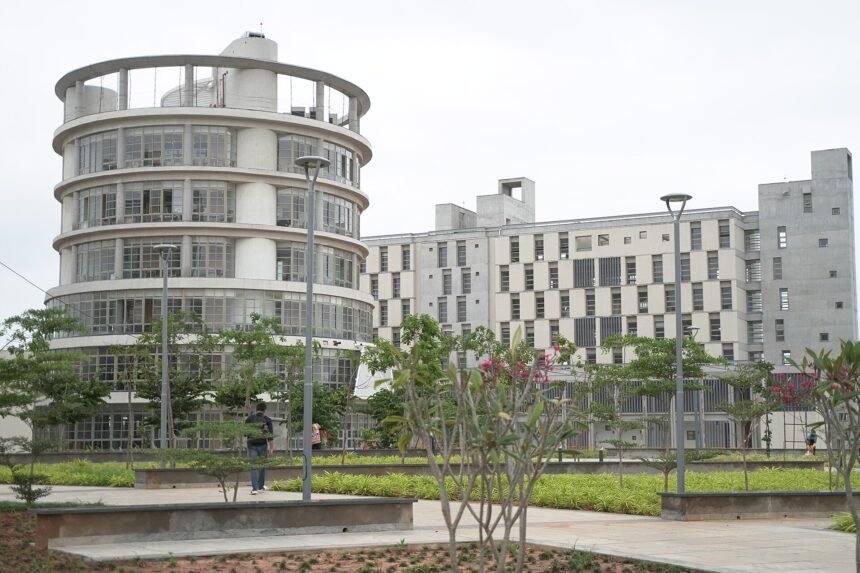
In March 2019 he gave away another 34% of Wipro, worth about US$7.5 billion at the time. That took his total philanthropic endowment to about US$21 billion, or 67% of Wipro’s economic ownership, as reported by Bloomberg and Scroll. The foundation also runs Azim Premji University in Bengaluru, whose campus is pictured above.
The giving continues. On November 2, 2026, the foundation launched a Social Startups Programme for first-time founders of grassroots organisations, Business Standard reported. The first cohort will have 100 people, applications are open until December 31, 2026, and selected founders begin an eight-month seeding phase from April 2027.
What readers can take from it
- Responsibility can arrive early. Premji did not choose the timing. He learned by doing.
- Watch for gaps others leave. IBM’s exit was a setback for India’s tech scene. Wipro treated it as an opening.
- Don’t drop what works. The soap and oil business kept running even as IT grew.
- Wealth can be a tool. Premji’s foundation now matters to millions of schoolchildren who will never work in tech.
Readers may also like our story on Narayana Murthy and Infosys, Wipro’s long-time rival from the same Bengaluru IT boom.
Reporting based on Business Standard, Business Standard/IANS, Scroll, Wipro and Business Standard (November 2026).
Featured image: Shashwatdc, via Wikimedia Commons (CC BY-SA 4.0)