
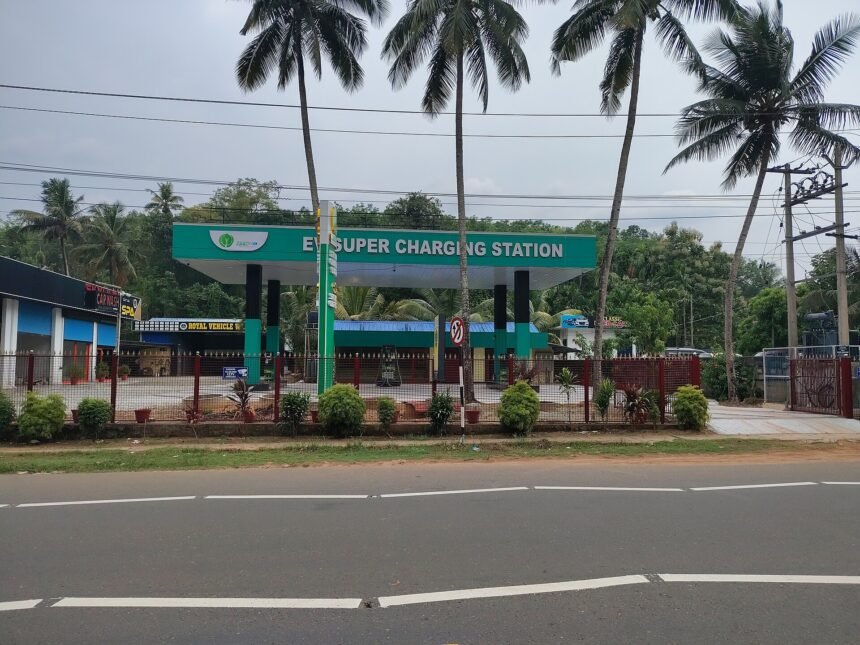
Delhi is getting 540 new public charging points spread over 180 locations, and the timing is not accidental. The Delhi EV chargers project, announced by officials on November 25, comes barely five weeks before the city stops registering new petrol, diesel and CNG three-wheelers and small goods carriers.
What the Delhi EV chargers plan includes
Delhi Transco Limited, the state power transmission company that the Delhi EV Policy 2026 names as the nodal agency for public charging, has started picking operators who will build and run the sites. The project falls under the Centre’s PM E-DRIVE scheme and uses a charger configuration approved by the Ministry of Heavy Industries.
Every one of the 180 sites will carry the same three-unit set-up, according to an official document cited by PTI and Millennium Post:
- A 12 kW charger with two guns for electric two-wheelers and three-wheelers
- A 60 kW charger with two guns for electric cars and N1 goods carriers (light delivery vans and pick-ups)
- A 120 kW fast charger with two guns
That is six charging guns per site.
The cost is estimated at about Rs 62 crore. On November 25, Education Minister Ashish Sood, speaking at a South Delhi school’s electric bus launch, put a figure of Rs 125.69 crore on a project for 540 chargers across 180 locations, mainly along school bus routes, according to Hindustan Times. Officials have not explained the gap between the two numbers, so treat the final cost as unconfirmed for now.
Where the chargers will go
The sites are split into two packages of 90 each. Package 1 mostly covers west and north Delhi. Package 2 covers south Delhi, New Delhi and east Delhi. In central Delhi, six shortlisted sites sit around Inderlok, Pratap Nagar, Shahi Idgah and the Kamla Market and Lok Nayak hospital area, with two more at Rajghat.
Why the deadline matters
The Delhi EV Policy 2026 sets hard dates. From January 1, 2027, only electric three-wheelers and electric N1 goods carriers can be newly registered in the city. From April 1, 2028, the same rule covers two-wheelers. That means thousands of auto drivers and small transporters will need reliable fast charging within months, and most of them do not have a parking spot where they can install a home charger.
The Commission for Air Quality Management (CAQM) has also set Delhi a target of 32,062 EV charging points by December 2029. Against that, 540 is a small step.
The push is tied to air pollution, which has kept Delhi in the “poor” band through much of November. Road transport is one of the larger contributors to PM2.5 in the city, and the government document says electrifying high-use vehicles such as autos, delivery vans and two-wheelers is central to its clean air plans. The same week, older vehicles were in the news too, after the Supreme Court’s remarks on which vehicles may be allowed in Delhi.
School buses are part of the picture
A separate rule under the 2026 policy requires schools to convert at least 30% of their bus fleets to electric by March 31, 2030, with interim targets of 10% within two years and 20% by the third year. Sood said charging is being built along school bus routes at the same time. “It is rather a gradual process,” he said.
Vasant Valley School in South Delhi has already replaced its CNG and diesel buses with 14 electric buses that carry over 400 students. Principal Sharmila Bakshi told HT the switch was largely smooth, though the school had to add routes because the electric buses carry fewer children than its old CNG ones.
What it means for EV owners
- No dates yet: Operators are still being selected, so do not expect these chargers to be live in December.
- Mixed use: Each site serves two-wheelers, autos, cars and light goods vehicles, so queues at busy spots are possible.
- Subsidy support: PM E-DRIVE has Rs 2,000 crore for public fast chargers nationally and offers an 80% capital subsidy on upstream infrastructure such as transformers and cabling, which should help operators keep tariffs in check.
The real test will be uptime. Officials themselves note that user confidence depends on finding a charger that works, and on being able to pay without trouble.
Reporting based on Hindustan Times (PTI), Millennium Post, Swarajya and Hindustan Times.
Featured image: Manukrishnan80, via Wikimedia Commons (CC BY-SA 4.0).




