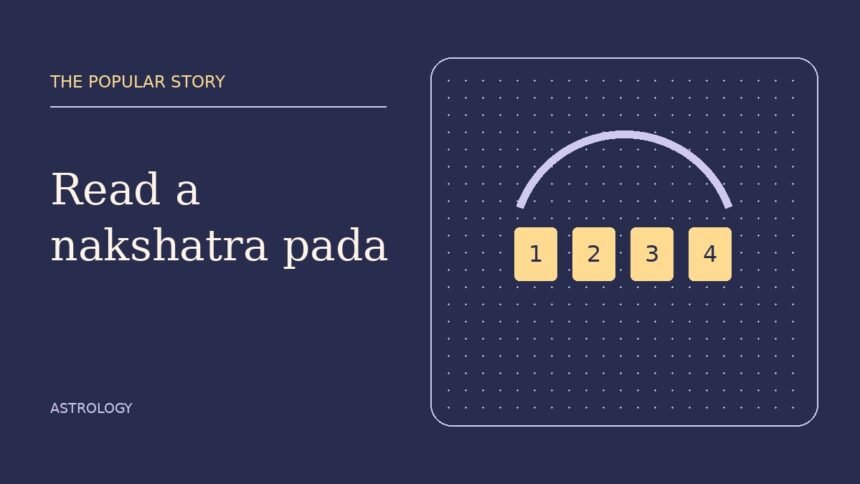
A birth chart prepared using Jyotish conventions may list a nakshatra name followed by a number from one to four. The number refers to a pada, a subdivision of that nakshatra. If two relatives have the same nakshatra with different pada numbers, the labels describe different positions within the same named section of the chart. Understanding that distinction can make it easier to read a report and to ask a calculator which position it used.
Drik Panchang’s reference page for name syllables is organised around 27 nakshatras and their 108 padas. The total comes from assigning four padas to each of the 27 divisions. Although the page applies this arrangement to a traditional naming practice, its layout is also a useful way to see how the smaller entries fit under the larger ones.
Read the name and number together
Imagine a strip split into four equal boxes. You could name the strip and then number the boxes in order. The name tells you which part of the larger arrangement you are looking at. The number tells you which of its four subdivisions the chart has assigned to the point in question. A chart entry can be copied as a pair, such as a nakshatra name followed by its pada, so another reader can identify the same result.
In a birth chart report, look at which celestial position the row means. A general birth report often identifies the Moon’s nakshatra. A table that goes through several planets may give a nakshatra and a pada for each entry. If two screens disagree, compare their row labels before assuming either value is incorrect. One may be giving the Moon’s subdivision while the other is describing a different chart position.
Boundaries make input details important
A small difference in a recorded birth time may make little difference to a label when the calculated position is far from a boundary. Near a division, a change may give a different name or pada. Someone comparing two charts should enter the same date, place and time. It is worth checking AM or PM and the time zone, especially if the birth occurred outside the country where the chart is being prepared.
Different chart settings can also matter. A sidereal calculation can use a convention known as an ayanamsa. The Swiss Ephemeris documentation describes the availability of different sidereal approaches. Write down the setting a calculator used when comparing a result. Then vary one item at a time if you want to see what explains the difference. Starting with several changes at once makes it hard to tell which choice led to a new chart label.
What the naming table can tell you
Some families use traditional syllable associations when considering a name. A published table can help someone check which suggestions a particular tradition attaches to a chart entry. It helps to keep the language, spelling and source with the note, particularly when a name or sound is written in more than one script. A list being used for a family practice can supply options for discussion without settling how each family chooses among them.
You can use the same care when discussing an interpretation. Name the chart technique and the tradition that informs the reading. Interpretations belong to astrology, and families or practitioners may approach them differently. A precise chart label is useful because it tells you what was calculated, even when two people interpret the result in different ways.
When sharing the result, include the nakshatra, pada number, chart feature and calculation source. If the time of birth is approximate, include that fact as well. This modest record turns an isolated chart abbreviation into something another person can check. It also gives a practitioner a clear place to begin if a family later wants to compare two versions of the same reading.
Sources
- https://www.drikpanchang.com/swar-siddhanta/nakshatra/nakshatra-pada-swar-siddhanta.html?lang=en
- https://www.astro.com/swisseph-download/doc/swisseph.pdf
Original editorial illustration prepared for The Popular Story.